In the last Fun With Maps, we talked about a Pennsylvania congressman drawn out of his own district by mere yards. Though that's a particularly targeted example of gerrymandering, it's certainly not the most egregious. Let's look at some of the most rigged.
The Horseshoe: IL-04
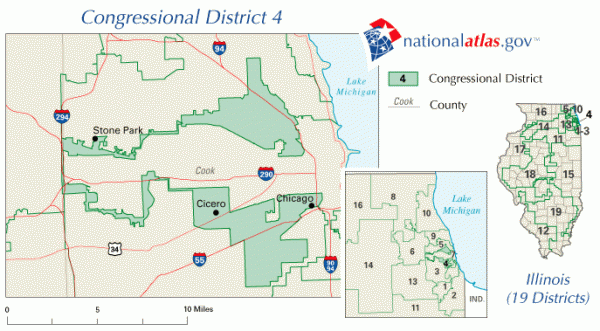
To create a Hispanic-majority district in the Chicagoland suburbs, the state of Illinois combined a Puerto Rican neighborhood with a distant Mexican neighborhood via a nonresidential strip of Interstate 294. The problem? The highway is eight miles west of either enclave.
The Court Case: NC-12
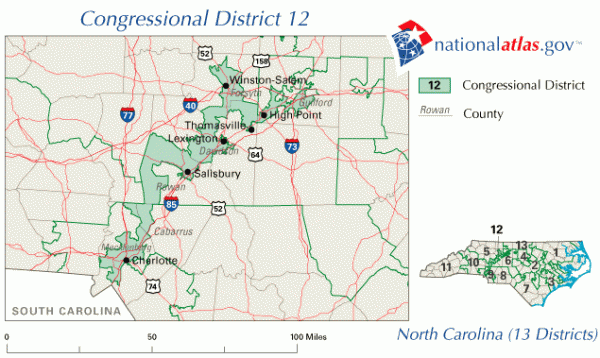
Pro tip: If you're looking at a long, narrow district, you're probably looking at some gerrymandering. When North Carolina gained a seat in the House of Representatives following the 1990 census, the state set out to create a black-majority district in NC-12. The twelfth initially followed Interstate 65 from Gastonia to Durham. Durham is 160 miles south north of Gastonia, at its widest the district was less than 20 miles across. The current version is the result of a 1993 Supreme Court ruling that the shape of the district violated the Equal Protection Clause. What you're looking at now is actually considered acceptable.
The Snake: MD-03
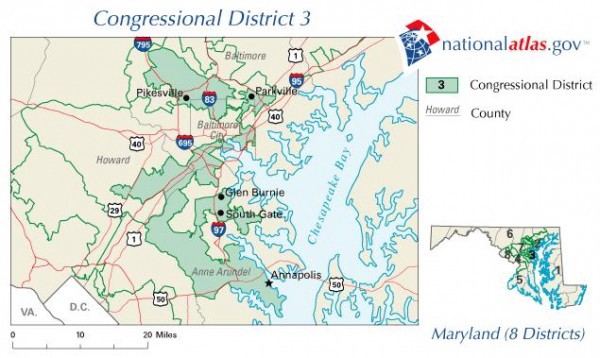
How do you create a Democratic-leaning district out of a smattering of Republican neighborhoods? You carve yourself Maryland's 3rd. Drawn to its current extent after the 2000 reapportionment, MD-03 appears barely cohesive. [We formerly credited the elections of Barbara Mikulski and Ben Cardin to this redrawing; Mikulski was first elected to the House in '77 and to the Senate in '87.]
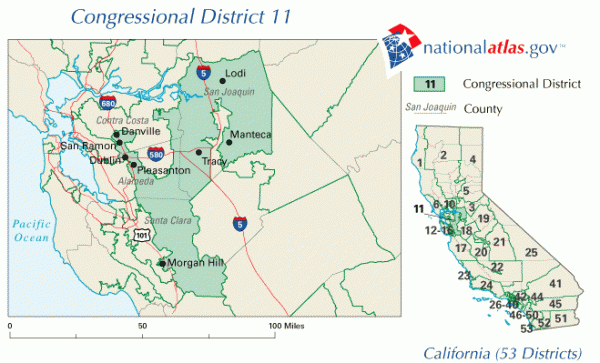
The Claw: CA-11

Gerrymandering doesn't always work out, especially if the candidate is particularly terrible. Take California's 11th. When it was reapportioned in the early 2000s, GOP incumbent Richard Pombo was barely hanging on to his swing state seat. Even though it was drawn very precisely to excise the Lawrence Livermore National Laboratory and surrounding scientist-filled neighborhoods, Democrat Jerry McNerney emerged victorious in a 2006 less-close-than-you'd-think race despite never having held elected office. Flash fact, when ranking all 435 districts by area, CA-11 is the median in size. Flash fact II, Pombo is now running for office in CA-19. He is not a resident of CA-19.
The Pie: Columbus, Ohio
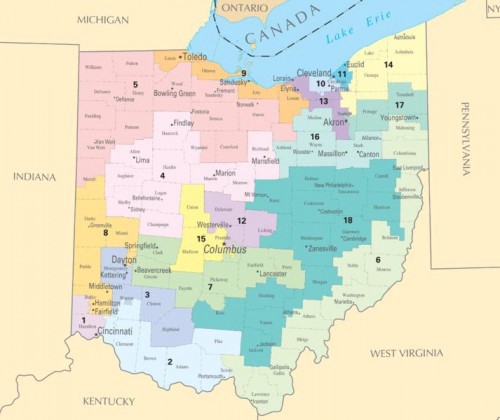
A gerrymander isn't always used to favor a specific candidate or voting bloc. Sometimes you just want to disenfranchise some folks. Spreading a voter group through several districts, also known as 'cracking,' can deny fair representation to a large constituency. The liberal center of Columbus, Ohio, is divided into three individual districts, each including a small slice of the urban area and a wide swath of the generally more conservative suburbs.
The Nonpolitical Gerrymander: AZ-02
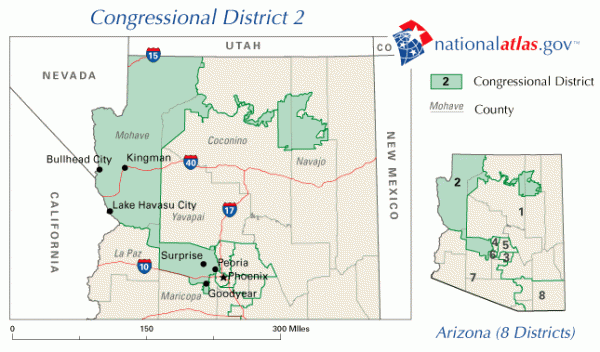
Similar to the Hopi/Navajo time zone pickle mentioned last time, the Hopi and the Navajo have had such major conflicts that Arizona lawmakers thought it best to separate their tribal lands into different districts. The blob of Hopi land to the northeast, which is completely surrounded by Navajo land, is connected to the rest of AZ-02 via a narrow strip of labyrinthine riverbeds. Navajo voters cast their ballots for candidates running in AZ-01.
The Meatwad: CA-18
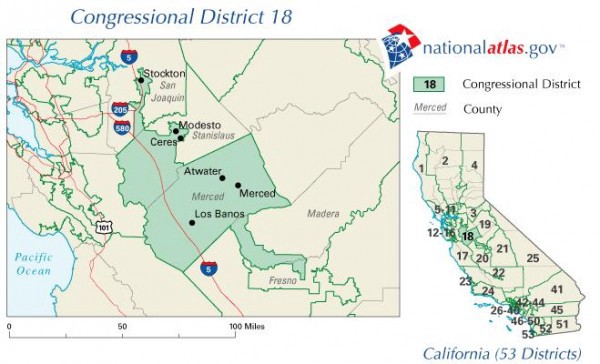
Not particularly gerrymandered, but it looks like meatwad.

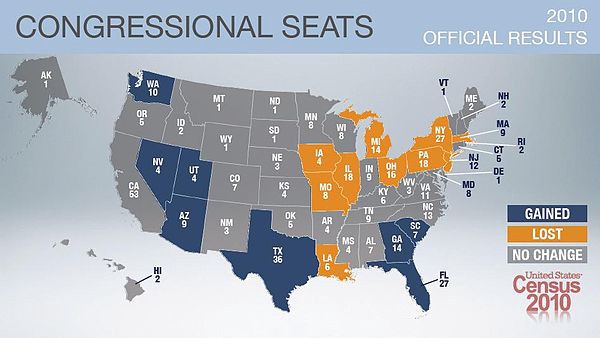
Districts are reapportioned in the years following the decennial census. This time around, Texas is gaining four seats and Florida is gaining two. Arizona, Georgia, Nevada, South Carolina, Utah and Washington will each gain one. Illinois, Iowa, Louisiana, Massachusetts, Michigan, Missouri, New Jersey and Pennsylvania are losing one seat. New York and Ohio are each losing two seats. North Carolina, with no change in seat allocation, is shaping up to be a doozy. Definitely a state to watch as the lines are redrawn. If watching isn't enough, may I recommend the Redistricting Game?
Victoria Johnson's hometown district, NY-27, looks like a bow tie.
Maps of Ohio and post-census reapportionment from the Census Bureau; all others from nationalatlas.gov.

i was curious about the meatwad link. i am still curious.
@roboloki
Meatwad make the money, see
Meatwad get the honeys, G
Travel in my car
Livin' like a star
Ice on my fingers an' my toes and I'm a
TAURUS
@roboloki I'm from the Meatwad! Formerly represented by Gary Condit, and that's the least of our embarrassments. Thank God (and the state's voters, for once) for the new independent redistricting commission.
I wonder if it's necessarily a plus for democracy for voting districts to be geographically compact or even contiguous at all. If the idea is that something approximating a checkerboard or honeycomb drawn across the map of your state is more likely to promote fairness because a good mix of population segments get thrown in together, okay, not sure that is the case but okay. And if your state consists of several islands, each with the population of a congressional district, then that might be the only way to do it. But if the idea is to let people with common interests form a voting group to represent those common interests (working-class neighborhoods north east west and south; rural areas radiating from a midsized city ...), then why not, as long as the motive is not transparently partisan?
@Tulletilsynet Strongly agreed! Why is it sinister to say that people in urban (and I am genuinely not using that as a racial code word, I mean urban vs. suburban) Winston-Salem and High Point have more in common with one another than either do with their respective suburbs/exurbs?
@Tulletilsynet
"The French builders, clearing away as mere rubbish whatever they found and, like their ornamental gardeners, forming everything into an exact level, propose to rest the whole local and general legislature on three bases of three different kinds: one geometrical, one arithmetical, and the third financial; the first of which they call the basis of territory; the second, the basis of population; and the third, the basis of contribution. For the accomplishment of the first of these purposes they divide the area of their country into eighty-three pieces, regularly square, of eighteen leagues by eighteen...When these state surveyors came to take a view of their work of measurement, they soon found that in politics the most fallacious of all things was geometrical demonstration...It was evident that the goodness of the soil, the number of the people, their wealth, and the largeness of their contribution made such infinite variations between square and square as to render mensuration a ridiculous standard of power in the commonwealth, and equality in geometry the most unequal of all measures in the distribution of men."
@Tulletilsynet: Define "transparently partisan."
@Tulletilsynet Or we could just get rid of districts and do proportional representation. And get a pony.
@Tulletilsynet A good counterpoint to this line of reasoning is what's going on in Wisconsin right now. The GOP has introed a redistricting plan so partisan and rushed that they are actually voting today to change a law first so that their plan isn't illegal. (Lawsuits have already been filed over it--as with everything in Wi now.)
The problem is that the similar interests it lumps together creates permanent Dem/GOP districts wherein the GOP has a permanent majority (potentially even if it loses the popular vote). The legislature will now be divided into rep districts that have almost no chance f swinging one way or the other any given year.
Interestingly enough, w/r/t this column, the Wisc. redistricting in Kenosha moved the boundaries just blocks from the sitting senator's house. He's one of the recalled Dems and the way the GOP drew the map, even his GOP challenger has been drawn out of the district for which he's competing. It's so fucked.
@jfruh There is this phrase, "All politics are local". Your local politician needs to address concerns of the local community and fight for specific concerns and projects. Much harder to do this if the voters are dispersed in various areas of the state.
Also if voters are dispersed across a large state, how will they organize themselves, have physical meetings and petition their representative in person?
@Tulletilsynet at the risk of sounding like a slightly unhinged civics class instructor -- gerrymandering is a huge threat to democracy.
gerrymandered districts are designed as "safe districts," that is to say noncompetitive districts, engineered to protect the incumbent by packing them with like-minded constituents. An incumbent with a safe seat is far more likely to maintain extreme political positions in line with the views of their constituents, and less likely to engage in the kinds of compromise so often needed in the legislative process. witness the inability of congress to handle the debt ceiling debacle among other questions.
ideally legislative districts should be drawn on a completely random basis -- without considering partisan, ethnic, or socioeconomic considerations. the more each district is a microcosm of the nation as a whole, the more likely individual representatives will act in the national interest. at least that's how it seems to me, open to hearing other views.
@deepomega Costume: left half of your body is a blue donkey, the right half is a red elephant. A purple stripe of meekness dividing them down the middle maybe?
@frabjous ideally legislative districts should be drawn on a completely random basis -- without considering partisan, ethnic, or socioeconomic considerations. the more each district is a microcosm of the nation as a whole, the more likely individual representatives will act in the national interest. at least that's how it seems to me, open to hearing other views.
OK, I'll bite: if that's so ideal, why bother having localized districts at all, other than the necessity to have someone to bring home the pork? Surely local representation is meant to express the fact that different localities actually have different political views. More to the point, as the country gets more politically polarized, I think that people often end up living around and/or spending time with like-minded people politically, and you'd actually have to do quite a bit of gerrymandering to get your supposedly perfect districts. I'd bet that some (though certainly not all) of the gerrymandered districts may look crazy on paper but represent the ways that people actually live and travel around their regions. Whereas you could draw very coherent-looking shapes on a map that would group together communities that rarely interact in practice.
On the other hand, I agree that politicians drawing safe districts for themselves is nuts. My own personal completely unrealistic suggestion would be to elect the house from multi-member seats (not huge ones: 3 or 4 members) using the Single Transferrable Vote, like they do in Ireland. It's a system where you rank all the candidates you'd vote for in order, and it generally produces proportionality (i.e. if two-thirds of people want an R and one third want a D, you're probably going to get 2 Rs and 1 D, whereas with single-memeber seats you can gerrymander things to produce 3 very safe Rs) and allow minorities to concentrate their voting power by rallying around a candidate. The districts would be big enough that they'd be difficult to gerrymander (many states would only consist of one or two districts anyway) and the outcome would mean that you couldn't completely block out minority opinion anyway.
The problem would be that the districts would be huge -- the Irish ones generally only have a few thousand people -- and counting would take forever and be prone to error. So, sigh.
@jfruh
why bother having localized districts? the simple answer is that local districts are meant to ensure accountability --- the smaller the better in this case (the huge size of federal house districts, with upwards of 400,000 people in them, is in my opinion hugely detrimental to having close citizen interactions with their representatives.) the idea being that citizens should be able to easily contact their representative, keep track of his or her votes, convey their concerns, etc. that's important of course.
re: the Irish example, that's interesting but I have significant qualms about any electoral systems other than Anglo-American first-past-the-post single member districts. not to get too far entangled in this question but I think this model tends to produce more stable and responsible governments. for the perils of proportional representation consider the case of Weimar Germany.
@frabjous not to get too far entangled in this question but I think this model tends to produce more stable and responsible governments. for the perils of proportional representation consider the case of Weimar Germany.
Sure, but take as a counter-example dozens of other governments over the course of the last 100 years, including the quite stable post-war Germany? Meanwhile look at our own House of Representatives over the past 15 years or so and see what single-member districts have gotten us.
The reason I like STV is that you still have a direct representative-to-constituent connection, as opposed to other forms of proportional represenation where people just get put on lists by party bosses. It's not one-to-one -- everyone would have three or four representatives -- but again that can ensure better representation for minority communities (ethnic or political). In our current politics, in many parts of the country reps are listening mostly to the hard core of their own party that they need to win their primaries. No amount of non-gerrymandering is going to fix this in many places -- are you ever going to create a competitive seat in western Nebraska or Brooklyn?
@Jim Demintia
An important point I neglected to mention above is that Victoria Johnson is ... wow. These are great features.
IL-04 is also known as The Earmuff.
Learn about gerrymandering and embrace your inner-artist at http://www.betterdrawadistrict.com. I'm a fan of the Sharky First.
At the risk of sounding like a technocrat, why not use some population-based tessellation of a State for the districts? It is produced by a definite procedure and doesn't seem to be any less fair that what is currently in place.
@Werner Hedgehog Constrained Voronoi diagram. Boom! Solved.
BTW, MD-3 isn't just an attempt to create a Democratic district; it's an attempt to create a *white* Democratic district. The actually quite contiguous MD-7 is majority-black; MD-2 and -3 were carved out of the surrounding predominantly white areas, with MD-3 being heavily Democratic and MD-2 being considered more balanced in '01 when it was drawn. The result is two twisting, entangled districts that are difficult to figure how they relate to each other spatially even when they're colored differently on a map.
Over the past decade, MD-3 (like pretty much the whole state outside the eastern and western extremities) has become reliably Democratic as well, so presumably there will be little incentive to repeat this insanity this year. Of course, now that the central part of the state is so heavily blue, the Democratic governor and legislature may try to add more Dems to the districts on the fringes of the state to make them more competitive, so maybe that will lead to further wackiness.
More on NC-12: Even after the North Carolina Senate changed party majority (Democratic to Republican) for the first time in many decades and are in the process of trying to redistrict everything, NC-12, in the latest map, still basically looks like this.
California is redistricting under a new law that uses semi-randomly chosen people for the committee. The draft maps do look a lot less gerrymandered, including the districts above. There are maps and info here. I have faith that someone will figure out a way to corrupt the process, though. It's practically un-American not to.
As a former resident of CA-23, I must protest its exclusion from the mismatch of silly maps. It was created to create an enclave of NIMBY, effete, chardonnay-sipping, college-town coastal Dems and keep out too many of those backwards, inbred, dim-witted Valley (and coastal valley) types.
The WSJ editorial page was happy to decry its existence.
i am really interesting this website
I think you mean Gastonia is 165 miles south of Durham in NC? Carrie, aren't you in or from Asheville or something? Tsk. I love you, The Awl, get it together.
I am having the best time redrawing districts using that game link. I might get fired!
@Sox I am in Asheville, but clearly need a primer on eastern part of the state. Fixed -- and thank you!
new idea for reality tv show: gerrymandr'd [?]
North Carolina just updated their maps for this year's redistricting. Check out the new NC-4 and NC-12.
http://www.publicmapping.org/
:)
this makes no sense to me! maybe its because im British and i swear putting together our constituency's for MP's is waaaaaay easier than this!