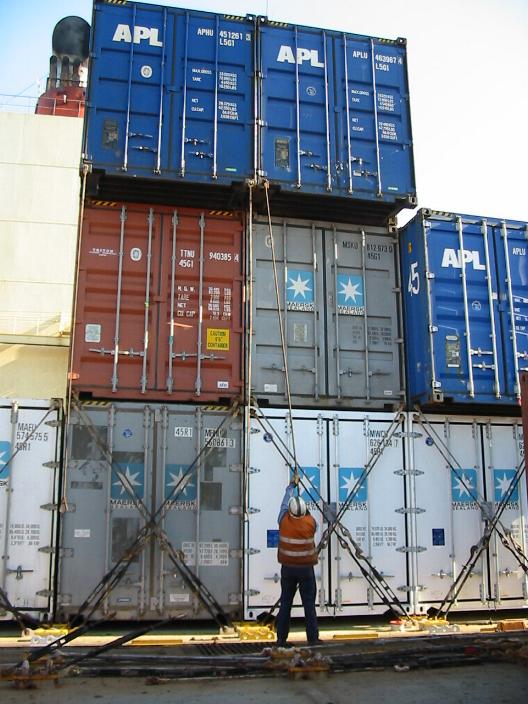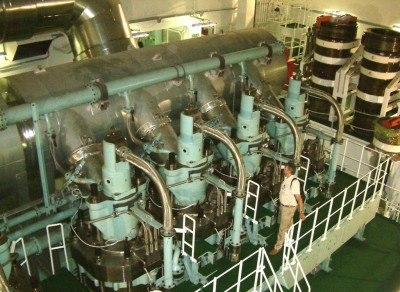
Some years ago I toured a container ship as a guest of its ambitious young Yugoslav captain. It was by far the most awe-inspiring company tour I’ve ever been on; the sheer size and scale of everything we were shown made us feel utterly antlike, awestruck, and then awestruck again, in a different way, at the magnificence of what people are able to achieve when they put their minds to it.
These container ships are commonly 300 meters long or more, and they burn a very filthy low-grade petroleum sludge the consistency of Nutella that must be warmed in order for it to liquefy to a combustible state. For this reason the engine room, which seemed the size of a ballroom in a ducal palace, was unbelievably warm, even though the building-sized engine was barely idling. There are nearly five thousand container ships in total (plus over thirteen thousand tankers and almost nine thousand "bulk carriers" of iron ore, coal and so on,) and all these enormous vessels are plowing back and forth across the ocean at every moment, spewing all sorts of muck into the air and water in order to get us our cheap consumer goods. The pollution created by these ships is gargantuan, despite the shipping industry’s ludicrous attempts to acquire the PC-friendly veneer of "green transport." Shipping contributes to the wreckage of ecosystems by belching rapacious jellyfish and other foreign beasts out of their ballast tanks; shipping contributes over 1.5 billion metric tons of CO2 exhaust every year (a rapidly growing figure); particulate matter from shipping exhaust rains onto the earth by the thousands of tons every day, infusing even the Arctic snow with soot and hastening the Arctic melt.
Container ship captains race across the oceans at maximum speeds in order to earn their bonuses; their ships are packed to the gunwales and beyond in order to make each trip pay as much as possible. There are complex, finely calculated risks of all kinds that the captains must take. For example if the weather is bad, it is quite possible that a container or ten will go springing straight off the boat and into the sea, so the containers must be arranged with the utmost care; the maximum number, but not so many that they go popping off in a storm. It's said that over 10,000 containers are lost at sea every year.
Photographs can’t do the Port of Long Beach justice because the scale is impossible to convey. When you are in it, this endless vista of containers stacked at various heights reaches straight across the horizon, acres and acres of colored boxes strewn across your whole field of vision like a Lego set for giants. When faced with such a multitude it’s hard to remember that an NBA player could stand up straight in each one of those tiny Lego boxes—well actually, one million real Legos fit in each one. Just one standard forty-foot container can carry as much as 59,040 pounds of Snuggies, shiny leggings, Maroon 5 t-shirts, blenders, Christmas gewgaws etc., and over 100 million container loads cross the oceans every year.
It’s a fearful sight in a way, the Port of Long Beach, this endless, crushing vista of metal and dust, with not so much as a blade of grass to relieve the impression of an infinite, silent or clanking perpetual machine, of a global engine, of "global industry"; compare this to say, a view of Central Park, and you’ll feel you’ve landed in a nightmare scene out of Mordor (or Isengard, I guess). Or, look at it from the point of view of human will and ingenuity, and you can’t help but admire, then, all the power, all the cleverness and craft that is required to keep this monstrous metal beast alive, an ocean of boiling oil pounding and churning through all its countless thousands of colossal hearts of hot steel.
So how absurd is this, that we should foul the oceans and the air with these huge container ships, that the polar bears should die and the cities drown, so that some feckless citizen can go to Wal-Mart, buy a plastic bird feeder Made in China and thereby feel helpful to nature at the low cost of $3.49?
How come is all this? Because the American idea has quite plainly concentrated itself in just one word: MORE. Not better, not "enough", but simply, MORE. How much do you want? The answer is always the same: MORE. More money, more things, more cars, more food, more booze, more bedrooms in a bigger house; bigger, faster, all you can eat, more than you want, for greed is good.
There’s really no point in telling people that they shouldn’t have what they want, because if they want it they are just going to have it anyway, if they can. But quite often we think we want things that in the event turn out to be not so desirable, like a whole lot of cocaine, for example, or we squeeze in a final helping of dessert.
Rich people very often have not thought for one instant about whether or not all this MORE is something they even want. It’s the water they’re swimming in, and therefore imperceptible. It’s really quite scary the way so many of the actual right-wing guys, not politicians but regular businessmen, who are saying they want MORE tax cuts because they want MORE for themselves, and they literally have never thought: what for? The other night at dinner I asked one very charming, well-off suit: Well, what’s the goal really? To get rich, he said dreamily. Well yeah but what for? I persisted. I mean, what do you want all this money for? (I said this kind of teasingly.) He looked at me in total incomprehension. "I am a good guy!" he exclaimed. "I won’t squander it!"
The mindlessness of this kind of materialism is clearly terrible for us all. But it's not the materialism itself that is bad; there is a logical basis to it, viz., a keen concern for the physical things that surround us, and that is a rational response to chaos and terror. Beautiful dwellings and gardens, beautiful clothes, lovely food carefully prepared; these things can be sought, acquired and enjoyed with restraint and intelligence, without ruining the earth. We could have a rational materialism based on quality and order, on respect for our ecosystems and environments; we could actually expand our materialism to include the earth itself in the surroundings we mean to protect and beautify.
There are signs that a new materialism is already begun in the Western world. The locavore movement, slow food and the rise of farmers' markets, the renewed interest in all kinds of craftsmanship; there's a move toward quality, toward buying things from local craftsmen, toward staying away from the big box stores; these are quiet and gradual changes, but they are important; maybe in the end they are more important than explicit attempts to mock or revile our greed, as Bill Maher did so effectively in his "Christmas Message" to Oprah Winfrey last week.
As distressing as it is to consider that there is a lot of suffering in this world, and as necessary as it is to put that consideration first in a sane worldview, making things around us as beautiful as we can is still a worthy employment. The usual Manichean (or should I say American) habit of taking everything to extremes never seems to reckon with the possibility of a middle ground. If we redefine our materialism with an eye to the full appreciation and use of all we have, without mindless gluttony or hoarding, that alone might do more to save the earth than any amount of satire, or lobbying or politicking.
Which brings me to the End of the World. When we hear so many scary things about the wreck that is being made of everything from politics to education to industry, it is very easy to become so distressed that the literal End of the World does, in fact, seem nigh; one fears that human beings might be fated to perish from the earth. But there is another way to look at this, which is that the world really does end every single day, and we have to remake it all again the next day. In reality, we must decide every minute how to make a new world. Maybe it's not doom that we are facing; it's a difficult and interesting problem, instead; one that requires that we not throw up our hands in despair, but that we use all our ingenuity and energy to solve.
Maria Bustillos is the author of Dorkismo: The Macho of the Dork and Act Like a Gentleman, Think Like a Woman.

Mark Osborne's CLAY-ANIMATED (yay) short, aptly titled "More":
http://vimeo.com/988244
SO good, so good. Thank you.
Also, Maria, this was wonderful.
Yes. Yes, it was.
This is brilliant. As a member of the affable and oft-suited class, it really is your responsiblity to have a response to questions such as those.
Being back in the midwest from Europe for the holidays that line from Bad Santa is stuck in my head - Do you really need all this shit? But I really do thing the pendulum is starting to swing back, friends buying old homes rather than fixing up new, flights to quality and permanancy rather than disposability, etc, etc.
"So how absurd is this, that we should foul the oceans and the air with these huge container ships, that the polar bears should die and the cities drown, so that some feckless citizen can go to Wal-Mart, buy a plastic bird feeder Made in China and thereby feel helpful to nature at the low cost of $3.49?"
How absurd is it to assume that citizens shopping at Wal-Mart are "feckless" and part of the group of people that always want more?
In one short paragraph you've managed to hit every easy Pavlovian button in order to condemn most of the population of America. Pollution? Check. Climate change (formerly d/b/a "global warming")? Check. Wal-Mart? Check.
I'm sure the nice warm glow that comes from broad condescension helps smooth over the reality of the situation so that it can all be handled under the stereotype covered by the phrase "Wal-Mart customer."
Which definition of "feckless" did you have in mind when taking aim at one of these largest targets available? "Ineffectual?" "Irresponsible?" "Feeble?" And why would you use it? Good lord, the sheer monstrosity of the "Wal-Mart" customer who would deign to throw away $3.50 on an item that would allow them to see a few birds outside their window. What a callous pack of self-centered, short-sighted Neanderthals!
It's bad enough that this whole unfortunate paragraph was included, but to connect those sloppy broad strokes to this "rich person" and their implied greed is crass at best and simply lazy at worst.
Here's what the lower-to-middle class actually wants out of life (and how Wal-Mart's low-priced goods help achieve it):
To live more comfortably.
It sounds lazy and selfish but this is what it actually boils down to (and at this point, I'm speaking from my own, still-current situation):
To have enough money available that a visit to the doctor doesn't get put off because the co-pay might leave the account short of money to fuel the vehicles needed to get to work.
To have enough money on hand that last-minute school requests for items/clothing/supplies/entrance fees/etc. don't mean you have to sacrifice your kid's self-esteem for a utility bill payment.
To have enough money on hand that when one vehicle needs repairs it doesn't just have to be left in the driveway until the next paycheck comes in.
To have enough money that a birthday doesn't have to coincide with a paycheck and a backlog of bills doesn't have to be put off until the tax return.
More or less, "living comfortably" just means not having to worry about money. It doesn't mean having enough to spend on sports cars, cruises, weekends in Vegas and the like.
To bash your average Wal-Mart patron as being the reason the climate is falling apart and attribute their desire to buy cheaper items to an overarching national greed is not only belittling, but completely disingenuous.
Just as surely as I don't know the day-to-day struggles in your life, I don't expect you to know what mine (or any other polar bear hating Wal-Mart shopper's) are. But it's just such a tempting target, isn't it? Good old Wal-Mart. It can always take more abuse.
So can, apparently, the average American. Take a long look at the items you singled out as being the presumably worthless cargo chewing up the environment on its way from (gasp!) other nations: "Snuggies, shiny leggings, Maroon 5 t-shirts, blenders, Christmas gewgaws…" Why, these are trappings of the "common" man! Look at how they live! Abhorrent!
But look at this, from near the end of this post:
"…maybe in the end they are more important than explicit attempts to mock or revile our greed."
Maybe this thought should have been considered earlier in the piece. A lot of what is dismissed here as "greed" is simply taking potshots at low-hanging fruit.
Holy frijole. (Maria here.) You quite misunderstand me. I didn't intend any condescension (though I can understand why you thought I did.) I have a blender myself, after all; I am American and bear my share of the blame. I'm saying that anyone who pops into a Wal-Mart and buys a bird feeder is feckless (by which I particularly mean, unmindful of the consequences of his actions) because there are methods of obtaining a bird feeder that do not involve putting more Chinese plastic onto a container ship. Nothing more than that.
At no point does Maria suggest that people should not be able to meet their needs; the people Maria questions for wanting "more" are the ones who already have everything they need: "Rich people very often have not thought for one instant about whether or not all this MORE is something they even want". And I took the mention of Walmart to be more of a dig at the corporation than the customer; note said customer is not feeding a family, but buying an item with a provenance that cancels out its purpose. She's telling us to be aware of where our crap comes from. OUR crap, not "common people" crap. And you'll have to work a lot harder to make me think there's anything wrong with that.
Maria - It seems a little petty to begrudge a person's purchase of a bird feeder because of their lack of knowledge of the supply chain and the damage done. While I am sure there are millions of people who don't know or don't care what nature et al. went through to deliver them this cheap bird feeder, there are still many people who have some awareness as to the greater harm caused by cheap consumer goods.
But when you add it all up, money's still money. You could plunk down a Whole Foods right next to the nearest Wal-Mart and I'd still do 90% of my shopping at the Evil Corporate Giant because I only have X amount of money to get groceries, etc.
I'm not a Wal-Mart apologist. I know what they do wrong. I'm not even sure that the money millions of people completely evens up the balance sheet. I do know that without Wal-Mart, many millions of people would be stretched even further financially.
Still, is it really that much better to spend $6 on a package of Whole Foods asparagus that was airfreighted in from Argentina during the middle of the winter (and harvested by someone making much less than what Wal-Mart pays)? All that does is make the purchaser feel superior to the Maroon 5 fan paying $3.50 over at the superstore for some pre-rotted produce.
C_Webb: You can take her statement as a dig at the corporation, but when you swing at Wal-Mart, you're swinging at a whole lot of the American public. It's even more condescending to take an additional swipe at the customer for their conspicuous consumption. So, they can buy cheap, bad-for-the-environment goods as long as it's only something that directly provides for their family? All else is wasteful and damaging?
It's a frickin' bird feeder! It's not a Lexus! And if you think I'm not seeing the forest for the $3.50 bird feeder, keep in mind that I didn't choose the example.
And swinging at Wal-Mart is just lazy shorthand for people who want to take the moral high ground without doing the homework. Union reps do it all the time. "Wal-Mart has low wages." Read: Wal-Mart is evil. Jobs that don't even require a GED pay low wages, whether it's at Wal-Mart or KMart or McDonalds or wherever.
People use Wal-Mart as an all-purpose punching bag to take shots at consumerism, big business, cheap Chinese goods, poor taste, white trash, instant gratification, urban sprawl and other related issues. At some point Godwin's Law is going to need to be expanded to include Wal-Mart which will probably suit their opponents just fine.
I understand where my crap comes from. I also understand that morally-pure products are out of my financial reach. Nearly everyone who makes an effort, legislative and otherwise, to determine how other people should eat, clothe themselves, etc. comes from a position of financial security. They want to remake the world in their own superior image and price a large percentage of the population right out of the game.
That's not just simply condescending. It's dangerous and it's immoral.
Holy frijole is right.
I still think this piece was really fucking good. Not flawless, but duh? These commenters are blowing shit way out of proportion. Maria, did you kick someone's dog?
I thought the description of container ships was fascinating, in its simultaneous awesomeness and horror of scale. Oh, the humanity...
But really, these comments! If you got one thing absolutely right, it's this: "The usual Manichean (or should I say American) habit of taking everything to extremes never seems to reckon with the possibility of a middle ground." Yes.
@Scrooge: Shooting low hanging fruit? I think she's going for the whole tree here.
@Shostakobitch: Clearly, compromise does not compute.
@Capitalist: "You can take her statement as a dig at the corporation, but when you swing at Wal-Mart, you're swinging at a whole lot of the American public." Let's not forget that the American public has also enjoyed swings at the whole lot of Wal-Mart, namely in the form of Buy-N-Large from the immensely popular Wall-E. Also consider so many James Cameron movies, from Avatar to Alien, where a giant corporation is always the ultimate villain. Nothing new or elitist, really.
Targeting Wal-Mart and gigantic container ships is not lazy. To many, they are harbingers of doom. This post, like every other this past week, is about the end of the world. Overreaching themes, nihilism, idealism, active imagination... par for the course.
@Capitalist "Still, is it really that much better to spend $6 on a package of Whole Foods asparagus that was airfreighted in from Argentina during the middle of the winter (and harvested by someone making much less than what Wal-Mart pays)?"
No. Whoever said such a thing!? You're seeing this class element in what I wrote that ain't there. I mention Wal-Mart not because it is cheesy or whatever but because it is huge--the scale of our consumption being the point.
Well, that, and a hope that the movement to keep things more local takes hold on a national or even global scale.
@p is for pee Dang. Amazing comment. Is there any chance you could come to LA and reason with my mom?
Feckless describes this post to a tee.
Yeah, why pick low-hanging fruit? Shooting it is much more fun -- and saves you from having to use your blender when you've finally got it off the tree.
Quite a disjointed leap from the containter ship stuff to an attack on rich people. How many millionaires do you see shopping at walmart in maroon 5 t-shirts?
In fact, though rich people are the only ones attacked by name they don't really fit with your social critique. Rich people are all about the locally sourced produce, saving the polar bears, beautifying the community, supporting the arts, and all that other obscure, improvisational, only listened to by affluent white people jazz.
The REAL complaint in this article is about poor people. Namely, that poor people in America have too much stuff and poor people in China have too many jobs. That and them caring about acquiring stuff you consider crap whilst not giving a shit about advancing the various causes you feel strongly about. The incoherent rich person bashing seems to exist only to conceal the point.
ALSO: No one got any more from having the tax cuts extended. They merely kept what they had prior.
Rich or poor, most Americans have a lot of stuff that came here from China on container ships. Not a class thing.
Perhaps Maria would be less dismissive of affordable goods that don't look like Central Park if container ships were the sail-driven vessels of yore or were powered by galleys of slaves in bespoke tunics (admittedly that would solve the pollution issue).
The real key to reducing consumption is ceasing to exist. I blame the lack of fescue at a massive industrial port on the marked lack of hegemonic warfare these days.
Um, I agree with a lot of what is being said, but the fact of the matter is that transport by sea is one of the most efficient forms of transport (with the exception of rail, and it can be argued that ships provide transport across areas rail can't bridge.) As you said, the scale of everything is enormous. An enormous amount of cargo is moved by burning relatively small amounts of fuel. And while many forms of global transport are somewhat repugnant in their solely materialistic purpose, a lot of shipping also serves to feed populations and allow trade across the world. I guess we could stop trading between nations, as that has seemed to work well for North Korea.
True points. (And why do you except rail?) -- Someday, not too far off, all these ships are going to start burning refined fuel instead of the residual Nutella, as Maria well describes it. (Certain coastal regimes already require ships to switch to diesel in their waters, and the next step will be for groups of flag states to make the same move with respect to all ships that fly their flag. Look for the US to be first and Panama and Liberia to be last.) And that will be good, as far as it goes, but the good will be greatly offset by the fact that the world's refineries will then have to refine a vast amount of fuel that is currently going right to the ships' engine in unrefined or Nutella form. (The capacity to distill that much clean petroleum product does not currently exist in the world, so the ships couldn't just switch over today even if they preferred to do so.) Another point that should be considered is that the dirty ship exhaust is offset by the vast number of truckloads (let alone planeloads) of cargo that a ship eliminates. When you put five thousand containers behind trucks and drive them across the US or Europe, you are hurting the atmosphere more than if you put the same five thousand containers on a modern containership and sail it from China to Rotterdam or Long Beach.
If you're feeling so defensive about the amount of cheap crap you consume, maybe try consuming less cheap crap and see how that works out for you? Instead of attacking a blogger for pointing out that Americans, rich and poor, consume a lot of cheap crap? It is actually possible to continue existing while consuming slightly or even significantly less.
That this dialogue is so passionate, sincere, and reasoned, is queasy proof that wealth, and those who possess it, has us all by the nuts.