Monday, December 20th, 2010
51

Current Senators Who Voted For, and then Against, 'Don't Ask, Don't Tell'

John Kerry (D-MA)

Herb Kohl (D-WI)
Daniel Akaka (D-HI)

Kent Conrad (D-ND)

Christ Dodd (D-CT)

Dianne Feinstein (D-CA)

Tom Harkin (D-IA)
Daniel Inouye (D-HI)
Jay Rockefeller (D-WV)

Frank Lautenberg (D-NJ)

Carl Levin (D-MI)

Patty Murray (D-WA)
Harry Reid (D-NV)
Barbara Mikulski (D-MD)

Patrick Leahy (D-VT)
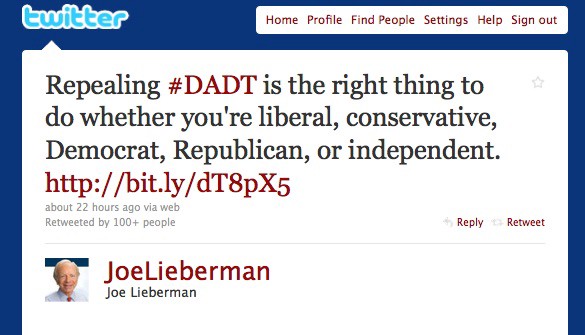
Joe Lieberman (Asshole Hypocrite-CT)

Abe Sauer really can't stand Joe Lieberman either.

51 Comments / Post A Comment

Tyler Coates (#451)

I'm confused about what this means. Mark Warner is a Democratic senator from Virginia – not a Republican. When did he (and the rest of these senators) vote for Don't Ask, Don't Tell?

Abe Sauer (#148)

Yeah, that was John Warner. Fixed.

boyofdestiny (#1,243)

Not sure about the Warner bit, but I'm fairly certain Abe is talking about the first go-around for DADT, 17 years ago.

Tyler Coates (#451)

Right, that makes more sense. Mark Warner, who is currently in his first term as senator, was originally included in this list.

Abe Sauer (#148)

I'm curious, did some of Warner's success at the polls come from people who had been used to voting for a "Warner" for senate?

Tyler Coates (#451)

Well, I'd like to think that Virginians are too much like po-dunk bumpkins and can differentiate the two. He has a pretty good record as governor; he succeeded Jim Gilmore, who left the state in a massive deficit.

Abe Sauer (#148)

Do governors ever leave a state any other way?

Just for the record, Charles Moskos was a terrible professor, too.

cranniem (#1,762)

@maura I enjoyed his C-level classes. He took more of an interest in his students than 90% of tenured profs at that hellhole.

liznieve (#7,691)

Northwesterners Unite!

(Although I never had Moskos, I must admit.)

kneetoe (#1,881)

Your point being that sometimes things change for the better?

MaryHaines (#3,666)

Sometimes, when you kick the can down the street, you're just passing it to yourself. Being a career politician has its little inconveniences.

barnhouse (#1,326)

You can learn a lot in seventeen years, maybe. I am glad they voted for repeal. And I am NO fan of Lieberman, but the fact is he gets a lot of the credit for making it happen this time so thank you, Senator Lieberman, even though you have driven me wild with rage on innumerable occasions.

MatthewGallaway (#1,239)

My feelings exactly!

Abe Sauer (#148)

I think it's important to remember that Lieberman is running around now calling the DADT repeal "a civil rights issue." If it's a civil rights issue now, then it was civil rights issue back then. So the 1993 vote was a compromise on civil rights, which, of course, back then, the senators favoring DADT would probably not have called it a civil rights issue. The fact that most of America came around on the issue doesn't mean it became a civil rights issue once it became popular. I understand the way politics work, baby steps and all that, but we hold Robert Byrd's feet to the fire so we should with these politicians as well.

jfruh (#713)

But but but … these people voted for DADT 17 years ago when it was the more progressive of the options on offer, i.e., when the other choice was a status quo under which gays were barred from the military in all cases and were explicitly to be sought out and hounded out. A policy under which gays could serve openly in the military never came up for a vote in 1993, and a list like this can't tell us how many of these people would have voted for such a policy if it did. (I'm sure some research could uncover the answer.) You can make a very good argument that DADT put gay service members in a terrible ethical bind, but you can also make an argument that DADT was preferable to the previous policy.

(There's also a third argument to be made: that had DADT not been put in, the gay ban would have been repealed in full earlier, whereas with it in place those homo-uncomfortable lawmakers who couldn't stomach an outright ban could tell themselves, "Well, we have this compromise in place that allows gays to serve." But I'm not sure that outcome was predictable in 1993.)

Anyway my point is that this list isn't put well in context. The point is that a vote to implmenet DADT in 1993 was a (compromise, incrementalist) vote for improved civil rights, whereas a vote to keep it in place in 2010 was a vote to block an improvement in civil rights. Say what you will against incrementalism and compromise — and I'm happy to say it with you — but the two votes don't mean the same thing, at all.

oudemia (#177)

Yes, this.

Tyler Coates (#451)

I agree. As with everything else, it's not so cut-and-dry, and I think it's worth looking at the bigger picture of how attitudes in general about homosexuality have changed within "the mainstream" before coming up with a lit that, honestly, seems needlessly flippant. I know I'm a jaded gay who has never really had to suffer with discrimination in the same way that previous generations did, but I'm happy to be able to admit that, frankly. I don't believe that these senators' voting records on the issue are clear examples of hypocrisy.

boyofdestiny (#1,243)

The beauty of a Listicle Without Commentary…

Dave Bry (#422)

Yes. That's a good thing to note.

Tyler Coates (#451)

Well, sure, but I think a statement such as the one implied could use some context and commentary. I'll also mention that the last item in this list in fact does include "commentary" of some sort.

Abe Sauer (#148)

I certainly understand this. And, to add commentary to the listicle without commentary, it should be noted that some senators who probably supported gays serving openly spinelessly voted for HR2401 anyway. A few years later Lieberman voted for the Defense of Marriage Act so I'm not sure he was such a candidate. (Note: RIP Russ Feingold, who voted Nay both times on this).

If I remember right, the "don't ask" part of this policy was a Presidential directive tacked on at the end, with Congress having voted essentially for the full existing ban. So, again, if I remember this right and please somebody correct me if I' wrong, there wasn;t much of a "compromise" when congress voted. the compromise was essentially what Clinton added.

I personally think the real telling thing here is that all of these senators are still in office 17 years later.

Abe Sauer (#148)

Meaning that Feingold voted "against" DAT both times. Nay first. Yea second.

joshc (#442)

Yes, thank you. It's crazy to remember that 17 years ago this awful and convoluted policy compromise was actually some kind of progress.

VTBen (#4,892)

lol "Christ Dodd"

Abe Sauer (#148)

Yeah, I'm leaving that.

Matt (#26)

That guy played bass in Nirvana.

Pop Socket (#187)

Perzactly. Back then DADT was the progressive half-loaf position. Far more interesting would be a list of senators that voted against DADT back then but had a change of heart and now voted for the repeal.

hockeymom (#143)

I think this list says a lot more about the senators who STILL voted against the repeal, 17 years later.
John McCain, I'm looking at you.

And a special shout out should go to Joe Manchin (D,W.V) who couldn't be bothered to vote on this issue or the DREAM Act because of a holiday party. (And the fact that he would have voted against both.) You, sir, are a true profile in courage.

DoctorDisaster (#1,970)

How DARE they make us work on stuff in DECEMBER that is disrespectful to CHRIST! The only RESPECTFUL thing is to get drunk at parties.

chrisafer (#1,322)

Lisa Murkowski wasn't in the Senate in 1993, her father was.

Abe Sauer (#148)

Sigh. yes. Thank you.

NinetyNine (#98)

Commenticle without Commentary: Errors in Abe Sauer's 70 word post.
1. Mark Warner was not a senator in 1993 and is a Democrat.
2. Chris(t) Dodd (sp)
3. Mark Pryor was not a senator in 1993. Likely refers to his father David Pryor.
4. Per above, Murkowski.

Abe Sauer (#148)

Noted above, I'm leaving Dodd alone.

Matt (#26)

No I think it's Richard Pryor, dude.

jfruh (#713)

The presence of not one but two parent-child senator pairs from the 1993 and 2010 lists is interesting data in and of itself.

Tyler Coates (#451)

That'd be a good listicle without commentary.

MaryHaines (#3,666)

Parent-child pairs in Congress are much less fun than parent-child pairs in sports.

aloysius25 (#9,109)

So anyone who voted against DADT in 1993 is some kind of leftist hero, right? Note the asterisked names.

Boxer (D-CA)
Brown (R-CO)
Coverdell (R-GA)
D'Amato (R-NY)
Dole (R-KS)
Domenici (R-NM)
Feingold (D-WI)
Gorton (R-WA)
Gramm (R-TX)
Hatch (R-UT)
Hatfield (R-OR)
*Helms (R-NC)
Mack (R-FL)
*McCain (R-AZ)
Metzenbaum (D-OH)
Nickles (R-OK)
Packwood (R-OR)
Pressler (R-SD)
Roth (R-DE)
Specter (R-PA)
Wallop (R-WY)
Wellstone (D-MN)

Politics is about persuasion. Once you've persuaded someone to change his mind, is it good form to call him a hypocrite?

Abe Sauer (#148)

Well, the "why" of the vote is also important. DeMint just voted against the tax cut extension but it wasn't because he thinks the rich need to pay more.

jfruh (#713)

Politics is about persuasion. Once you've persuaded someone to change his mind, is it good form to call him a hypocrite?

This is always the problem for true believers in politics, though, isn't it? I read a great quote from an anti-abortion activist type talking about Mitt Romney, saying basically that, we spend all our energy trying to convince people we're right, but are deeply suspicious of anyone who actually comes over to our side since they haven't been pure believers since the dawn of time. (In Romney's case, of course, it's becuase his desperation to be elected and lack of an actual belief structure is shockingly transparent, but the larger point stands.)

Abe Sauer (#148)

I would hazard that "desperation to be elected and lack of an actual belief structure" is true most of the time.

And I grasp the concept of the politics of persuasion and that politics is persuasion. In areas of economics and, say, foreign policy this give and take thing is, while often ugly, understandable. BUT in areas of civil rights this should not be forgivable, even if we all have to just live with the way it is.

jfruh (#713)

I guess I don't quite get why it's not forgivable when it's movement in your direction. Do you believe that (for instance) every baby boomer was born hating gay people and will always hate gay people, and every Gen Xer was born loving them, and any time a member of either group moves proclaims differently it's false somehow?

To put it another way, would the rhetoric surrounding this vote matter less if Joe Lieberman et al had stood up and said "We did a great disservice in putting this policy into place in 1993, but now we make that right"? What if they said "What we did in 1993 was the best we could do at the time, but now we pass this long-overdue advance?"

Abe Sauer (#148)

Actually, yes. One of the most infuriating things about this is the credit taking, ESPECIALLY from a guy throwing around the term "civil rights" despite having outright said (and voted likewise) "I believe gay marriage is wrong."

I am all for movements in the right direction (though I'm not sure I follow your baby boomer thread). But if the expectation is compromise, there has to be a considerable number of (inevitably let down) true believers to offer up a position which the politically inclined can abandon for compromise.

aloysius25 (#9,109)

Sure! But you've made no effort to discover why these senators in 1993 voted yes. I mean, Ted Kennedy voted for it.

sigerson (#179)

This is an infuriatingly misleading post, especially for The Awl. Where is the "Dislike Abe" button?

the teeth (#380)

Didn't Barney Frank grudgingly vote for the initial DADT?

Ryon (#9,150)

Yes, he did vote for it, though there's no information here as to how grudgingly: http://clerk.house.gov/evs/1993/roll474.xml

And for the record, I too dislike Lieberman but I think this post is unfair in its implications. Like it or not, pro-DADT was the progressive position in 1993 (and no I don't like it).

Post a Comment