
Two McNally Jackson Booksellers Argue About Jonathan Franzen's 'Freedom'
by Dustin Kurtz and Sam MacLaughlin
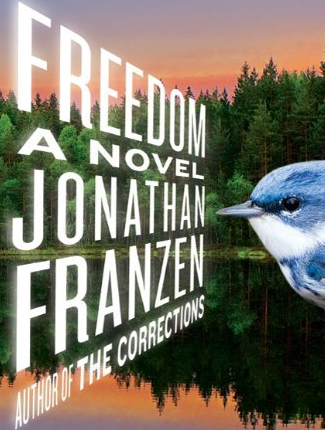
Sam MacLaughlin: Hi Dustin!
Dustin Kurtz: Hello Samuel. So, introductions of our various stances, maybe?
Sam: Maybe! We are both sad young white literary men, yes?
Dustin: Emphasis on the sad and white, yes. Our manliness being in dispute at times.
Sam: At times. I do carry a tote bag. And: you’re not a female novelist, are you?
Dustin: No, so I think we can agree that my dislike of this book won’t come from anything as disagreeable as politics. Unless there is a political party fighting for better prose?
Sam: Which book!
Dustin: THE book, young sir, the book of our generation!
Sam: The book that takes the datum of our shared millennial life, and limns, like, mostly everything that needs a limning?
Dustin: The tome, generations hence, that people will use to judge your immortal white literary soul.
Sam: Freedom!
Dustin: Freedom!
Dustin: I wish we could have done that simultaneously.
Sam: It was pretty simultaneous.
Dustin: So you would choose this book over the life of your firstborn, yes? Whereas I think it has flaws (so nuanced)! Sometimes little but.
Sam: I think it has flaws, too, but I would say that this is a great book. I am not an enemy of Freedom.
Dustin: Can we actually get seriouschat here and make a distinction between a great book and a great novel?
Sam: Let’s. I bet you have ideas.
Dustin: I do! Greatness aside (very much aside) this book is a successful novel in many ways.
Sam: Agreed.
Dustin: When we talk about The Novel (all the time, I’m sure) we’re talking about a specific layering of detail, adherence to some rules, all of which this does very well.
Sam: But?
Dustin: But if we want to talk about the worth of a book more generally, we have to look at the quality of the writing, and maybe it’s value to readers. Did I say seriouschat? Apparently I meant didacticchat.
Sam: They are probably the same thing. Does didactic-chat need a hyphen? That one is harder to read.
Dustin: What I’m saying is that if all it takes to be a good (honestly, not great, and definitely not Great) novel is the creation of this dense clay flesh around the frames of these characters, then Franzen is good.
Sam: And yet, as a member of the backlash (how does it feel?) you are denying greatness and Greatness. On what grounds? I’m still trying to figure out how it’s possible to hate Freedom. Also Freedom by Jonathan Franzen.
Dustin: Well, so let’s not get too much into whether he accomplishes his goals of a greater worth outside of that book, because I’m not Emerson and anyhow we both believe pretty soundly in the value of literature for its own sake. At least for well-fed bastards like you and I.
Sam: You want to talk about the book itself then? That’s what you want to talk about?
Dustin: You are the worst Socratic interlocutor I’ve ever had, Zingerman McZing.
Sam: Zingerman MacZing, please.
Dustin: What I’m trying to do is throw out the idea that you and the rest of the damn world are not necessarily wrong, that this might be a good novel. But I’m maintaining that it’s a pretty bad book.
Sam: Oh. Snap.
Dustin: Franzen is not a detailed writer, but an incidental one.
Sam: Right: I could make the same joke I always make about Anna Karenina: 700 pages of gossip.
Dustin: And I think that is some of what people are talking about when they call him old-fashioned. Well, that and the codpiece.
Sam: Always the codpiece. What an odd choice.
Dustin: With Franzen it comes out in a flat omniscient third that just sort of smears everyone and everything with his clunky segue phrasing.
Sam: I was re-reading some last night, and the first line of every chapter (saving the Patty chapters, but probably even those) could be: “Did you hear?”
Dustin: But I don’t even dislike that about him.
Sam: You do dislike something. I still have no idea what it is.
Dustin: He’s very good at the floating narrator who also gives us hints of the attitudes, if not as much the voice, of many characters in quick succession.
Sam: Free indirect discourse! My English degree is worth something. He’s very, very good at that.
Dustin: Easy with that second very. He’s okay.
Sam: I’m still trying to figure what you don’t like!
Dustin: The writing. So, the book.
Sam: Like, sentence by sentence, you dislike this book?
Next: Does Dustin dislike the book sentence by sentence???
Dustin: Well, if “dislike” is all we’re talking about, I also dislike almost every character. What you mean is why do I think it is not a good book.
Sam: Right.
Dustin: I still think people can read it and enjoy it, and so it’s worthwhile in that regard. Also: population, coal, bitterns. I feel like I have to start quoting sentences?
Sam: Yes, let’s get specific. Which’ll allow me to let the snobbery of “people can read it and enjoy it” slide.
Dustin: You have the best come-ons. I don’t expect men in codpieces to be able to write the perfect sentence. I wouldn’t know it if I read it. But: “Here, all at once, Joyce’s face crumpled up terribly” might not be it. On the same page, Joyce “look[s] out a window woefully.”
Sam: Okay! But: I bet that’s in a Patty section, right?
Dustin: Please. The first Patty section is the best-written in the book. But yes.
Sam: I don’t think you can attack the prose of the book based on the Patty diaries.
And I’d argue Patty’s prose is intended to rankle that way
Dustin: 1.) They are half the book, so maybe I can use them to judge the book and 2.) Be honest, you just like that Conor Oberst gets a shout out. That’s fair about the Patty passages. They certainly rankle the fuck out of Walter.
Sam: But you are using them to judge to book as if they are presented straightfacedly, without ironic distance. As for 2.), yes, completely.
Dustin: Should I quote a Joey/Connie scene then? Right in the middle of the book? Those don’t suffer under Franzen’s coy “this is a diary” framing.
Sam: Wait, if you want, I could try to make a Larger Interpretive Point?
Dustin: Go for it.
Sam: Okay! So: I agree with you that none of the characters is perfectly “likable” (and I’m sure you agree that this is no way to judge a novel), but I think that Franzen is — argh, I don’t want to use the word “manifesting,” but here it comes — manifesting that dislike on a sentence-by-sentence level. The whole novel is vague: on the one hand, Volvo-owners are the worst; on the other hand, if I owned a Volvo, I would probably worry about weird noises my Volvo was making too. On the one hand, Walter’s project is going to save a lot of birds. On the other, they are displacing families and strip mining. On the one hand, Walter, on the other, Richard. Patty can be irritating, but also deeply sympathetic.
Dustin: You are arguing that this book is mimetic at the granular level.
Sam: Yes. And that its great success is getting you to keep reading despite the fact that we are snobs about sentences. Which I am! There were lots of groaners in there, but I somehow never groaned.
Dustin: I am still, in fact, groaning even now because of this book. I like your idea, and if I thought it were true I’d agree that Freedom (fucking Mel Gibson has ruined that word, yes?) is an incredible work a la Lispector’s Hour of the Star. And though that would be wonderful, if true, the book doesn’t sustain it.
Sam: How so?
Dustin: Support it, maybe. Doesn’t support it, like a codpiece with worn elastic.
Sam: Let’s not extend that metaphor much further plz.
Dustin: Your point then is not simply that irritation in general is built into the page at every level. You are saying that it is entirely contextual and specific irritation and bad phrasing.
Sam: That is not exactly what I’m saying, but close.
Dustin: If you were arguing that the book were subtly and purposefully irritating as a whole then okay, maybe he’s pulled a weird pastel-flavored Bataille thing in which every aspect of the book is bad. But if you are saying that the language of the book in its near-uniform clumsiness is meant to reflect the inner (and ALLCAPS OUTER) irritations of the characters, then I guess I’d say I’m surprised that Franzen wants all of his characters to sound like not-so-great novelists.
Sam: No! Not exactly. I think Franzen is using that ironic distance, and I think that that flat omniscient 3rd is mostly only ever as omniscient as “the neighborhood” (except Patty’s sections which are obviously Patty) and the narrative voice is deliberately not Franzen’s voice — we all know he can write sparkly sentences — but that of “the neighborhood.” And by presenting the story thusly (yep), Franzen opens up space for us to judge, but also to love. Though I might delete that. The italicized love.
Dustin: The distance is there, sure, and I think your point about “the neighborhood” is a good one, but again I don’t think the text bears it out all the time. Franzen draws too close. At the most generous we can say he’s tried what you’re proposing at times and failed at it more than succeeded. But yes, it’s interesting to read.
Sam: I think he’s succeeds more than not. Opinions!
Dustin: If you’re saying that the overall narration, even in the DIALOGUE! is his attempt, failed (yes) or otherwise, to reflect thought in this floating almost-close third, he’s certainly not succeeded there. Have you noticed his contractions?
Sam: Remind me about the contractions?
Dustin: He uses them so strangely. They feel far too few in the dialogue. We’ve also not talked about his silly thematic conceits.
Sam: Like FREEDOM?
Dustin: Like Patty and the team mindset? “Like birds,” Walter cawed.
Sam: “LIKE BIRDS!”
Dustin: I’ve read that he prides himself on the dialogue by the way. Like, he spends a lot of time reading those silly sentences with bad timing and silly anger aloud.
Sam: Till he’s hoarse!
Dustin: “Hmm,” Franzen thinks, softly caressing his codpiece, “this time when Walter shouts ‘bullshit’ over and over, should it be in italics or allcaps?”
Sam: BOTH! Now that we’re on Gchat all the time — we ALL OF US, not just you and I — those actually weren’t that obtrusive to me. Because I am so used to HYSTERICAL ALLCAPSISM. The Internet: It’s taking over our books.
Dustin: Is that it? I just wish I couldn’t read it and understand the distinctions in tone he’s trying to express? So you appreciate being trolled by Franzen, is your ultimate conclusion.
Sam: Yes. Whereas you do not. In all seriousness though, it seems like you and I think the novel is great/not-great for the same reason — i.e. the prose itself.
Dustin: Right, we both recognize the idiocy, but you believe it’s being put there, much like fluoridated water and nose-chips, as part of a larger plan. Nose-chips?
Sam: Nose-chips?
Dustin: Hey, you believe in them, not me. But yes, the prose is the major element in my disdain for this book.
Sam: Though it’s funny: in your good novel/good book distinction, in my mind it seems like Freedom should be (according to you) a bad novel but a good book? Like, the product of sentences following sentences is a novel, but the whole of the thing is the book. And I can easily imagine a perfectly crafted novel but a lousy book and a lousy novel but a great book.
Dustin: Apart from the perfectly crafted bit, that’s what I think this is. I think sentence by sentence it is poop by poop.
Sam: (We didn’t talk about the poop scene! (Let’s not. Franzen’s poopophilia is not a mystery I want to… dip my hands into?))
Dustin: But in the larger view is where I’m willing to give him credit.
Sam: Okay, but doesn’t it seem like the larger view ought to allow for Great Book-status?
Dustin: I think it is successful in that it IS readable, if not compellingly so like many people have said. And performs many of the duties expected of a novel with good old midwestern brio. See, but there is not just one consideration at this anything-above-a-sentence level.
Sam: What else?
Dustin: He succeeded at the form but failed as a writer and at imbuing the book with any value outside itself-again, a criteria I wouldn’t feel free to level if he weren’t so clearly striving to be read with just that in mind.
Sam: Not imbuing the book with any value outside itself is a very big claim, one that I’m not sure I want to try to dismantle, because then we’ll have to start talking about Literature and people will never read the Awl again. But: I disagree!
Dustin: Anyhow, I came into this very willing to call it a good novel, and you have convinced me that were he actively striving to irritate us at the sentence level throughout, which he isn’t because dude wants to sell books, then he would be a good writer and this perhaps a great book. Still no capital G, though.
Sam: Does that mean I win?
Dustin: You made an interesting point. You won my heart? But we both read the thing so of course we both lose.
Sam: Should we reward the people for sticking around with us for so long?
Dustin: Wait, are you saying goodbye? I have 500 more pages of bickering here ready to go (Pulitzer please).
Sam: I am more or less saying goodbye. We have books to monger! Ones even other than Freedom.
Dustin: Impossible sir, for without freedom what use is literature?
Sam: Like Coming & Crying, which we’ll have again on Saturday. Or Julia Holmes’ Meeks.
Dustin: Ah Meeks, very good. Very discomforting, but with less rape re-enactment.
Sam: Or the frigging Anthologist, for Chrissakes. That book: still a great book. 10% off to everyone on everything if they said that they read this thing on the Awl and oh my God it was so long and nobody won?
Dustin: Holy moly, I hope they don’t use the discount on this book.
Sam: We’ll let them use it on whatever they want. But what should we never forget about Freedom?
Dustin: I don’t know, the gross descriptions of cunnilingus?
Sam: Wrong! Never forget: Freedom isn’t free. It’s $28.
Dustin: Well, $28 and the cost of diminished expectations of your loved ones, hatred of the middle class, and at least two nights of your life. But that doesn’t show up on the receipt.
Sam: But also less if you ask for 10% off.
Dustin Kurtz is a bookseller, book reviewer, and maybe kind of a dick? He is from Michigan and lives in Brooklyn. You can also read him at his Tumblr. Sam MacLaughlin sells books at McNally Jackson; he bumblingly tumblrs for the store. They both run the Twitter. McNally Jackson Books is located at 52 Prince Street in New York City.