
Endless Boom and Bust: Two Proposals Towards a Way Out
by Carl Hegelman
The 1970s began in late 1973 and ended in early 1982. A decade-long hangover. The childish joie de vivre of flower power had faded by 1973, five or six years after the Summer of Love, three years after the breakup of The Beatles. The bloom was off the rose and a kind of cynical sense of entitlement had set in. To be cool in 1973 you needed to live in a squat (preferably in The Smoke, as we called London in those days), go on the dole and wear an Afghan coat. Brightly colored underwear was still OK, but the important thing was to be weary and jaded on the outside. A beard, if you could manage it, helped achieve this effect.
We were coming off a boom and about to pay for it.
In 1973, when inflation was already headline news, the Arab oil producers, responding to US military support for Israel in the wake of the Yom Kippur war, imposed an oil embargo, and the price of oil quadrupled in three months, from $3 a barrel to a staggering $12. (Current price: around $73.)
Sundry other commodity-producing countries thought that seemed like a good idea, the newspapers were full of predictions of a Third World of commodity-cartels “holding us all to ransom” (by which they meant getting the best price they could). One day the papers would report rumors of an impending shortage of lavatory paper and suddenly, with everybody rushing to stock up, there would be no lavatory paper on the shelves in Woolworth’s, not even the thin scratchy kind (eg Broncoâ„¢) so familiar to English bottoms of the post-war era.
It didn’t help that a year or two before, Nixon had taken the dollar off the gold standard and most of the major economic powers were printing money like Sunday insert-coupons. To cap it all, food supplies were short after a worldwide drought. Sugar, Nescafe, everything was going up. In Britain, inflation peaked in 1975 at somewhere around 25%. That doesn’t feel good. It’s like you’re getting a pay cut every week. Particularly not good for the Old Age Pensioners on a fixed income.
Some things you don’t really notice when you’re still at university, wrapped up in socializing, dissipation and drunkenness. You feel a vague sense of grievance when the price of beer goes up (Double Diamond 16p a pint! what a drag!), but you’re only dimly aware of the London stock market going down 70% — more than it had in the 1930s — house prices crashing (after going up 50% in a year by mid-1973) and the government having to step in to bail out banks, British Leyland (maker of the Mini, which in those days was for people who couldn’t afford a bigger car) and Rolls Royce.
These were blurry headlines you might half-see on the board at the tobacconist/newsagent’s door as you flashed by on your bike. Just The Usual Mess, you might think, if you were in a thinking condition.
At least in the UK we didn’t have to worry about getting airlifted to Vietnam and flown back in a body bag. Like the stock market, Vietnam was a remote story. What we had, apart from miserable grey winters, was those unions. Every week a different strike; even civil servants, for one (timid) day in 1973; sometimes it seemed nobody was working at all. This had been going on for at least a decade, but the winter of 1973–4 was kind of a low point because when the coal-miners came out, with oil also being in short supply, Britain went on a three-day week to conserve fuel, and electricity was rationed. We sat in pubs drinking beer by candlelight and it was too dark to play darts or bar billiards. All you could do was sing rugby songs. It was jolly, in a way, but also promoting a certain sense of grimness and impending doom. Whistling in the dark, as it were. Doom, anyway, awaited the Conservative Prime Minister, Ted “Teeth” Heath, who was ignominiously booted out while seeking a mandate against the coal miners in a snap election in that bitter February.
This went on for what seemed like a long time. Under the new Labour government, the unions were able to get wage increases of 25%, 30%, to protect themselves against the rising prices. Wages chasing prices, prices going up with labor costs, it was a merry-go-round indeed, and hard to stop once it started. People began to get very pissed off with strikes and unions. Taxes had to go up to fix the deficit. The top bracket (£20,000 and above) was up to 83%, and a new class of “tax exile” emerged-people who spent six months and a day each year at their houses in France to avoid British taxes. (One’s heart did not exactly bleed for them, but, dammit, an Englishman’s home is his Château? A bit thick.)
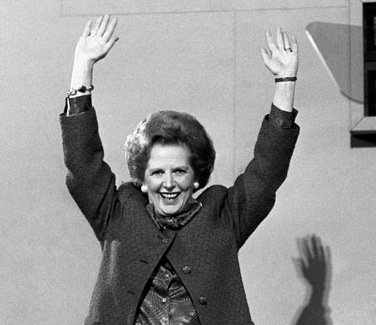
Margaret Thatcher was still a minor figure in the Conservative party, known to most as Thatcher The Milk Snatcher who, as Teeth’s Minister for Education & Science, had made her mark by stopping free milk for schoolchildren. But her time was coming. In 1975 she replaced Teeth as leader of the Blue Ribbon lot, and in 1979 the Conservatives came back to power.
The rest is history-ending, in 2007, with the same damn crash-and-burn. A 30-year swing of the pendulum, with the same result.
All this was really the culmination of a Socialist-egalitarian experiment that began when the Labour Party defeated Winston Churchill’s Conservatives by a landslide in the 1945 election. My generation grew up as almost the last beneficiaries of this experiment. Even the children of relatively prosperous families could go to university-whether Oxbridge or the local Polytechnic-pretty much for nothing. Health care was free. If you were low-income, you could get a Rent Allowance check. As students, the first thing you did when term ended and vacation started, assuming you didn’t want to take a job, was to apply for Supplementary Benefits-AKA, the dole. The newspapers were full of stories of people, generally men with families, to whom taking a job meant an actual decline in income: they would get paid more on unemployment than if they worked. Who knows whether the stories were true or not, but that’s what they said.
Why bring this up now? Well, the creation of an egalitarian society is a worthy goal. It seems particularly pertinent now, at a time when the gap between The Rich and the Not Rich is as wide as it’s been since the Robber Baron days-the so-called “gilded age”-before Teddy Roosevelt was President. Politicians are arguing over the best way to tackle our current economic difficulties, and in November economic policy will probably be a key issue. It’s an opportunity for a creative restructuring which can both help us out of this mess and create a more equitable, less polarized society. In order to do it, we need to know what works and what doesn’t. The Reaganomics/Thatcherite/Free Market model didn’t work-is that pretty clear now?
But the English socialist model didn’t work, either. So what to do?
Here’s a couple of interesting proposals:
1. Swords into Ploughshares. Robert Reich, the small but clear-thinking and humanity-packed economist, Labor Secretary during Clinton I, suggests substituting useful job programs (infrastructure, green energy, etc etc) for useless ones (building hardware we don’t need, like the C-17 cargo jet). The “defense” budget, at $950bn (if you include Homeland Security, Veterans Affairs, nuclear weapons management, and intelligence), is the biggest single component of the US budget. We spend more on “defense” than the rest of the world combined. Put some of that money into stimulus programs that actually result in things we need. It’s revenue-neutral, and there’s no military power without economic power, right, Boehner? Robert Reich is on fire right now, read his blog.
2. Scrap the current ragbag welfare system and implement a Negative Income Tax. An idea proposed by that notorious radical, Milton Friedman, in his 1962 book Capitalism And Freedom. Robert H. Frank, another very free-thinking economist and author of the radiantly thought-provoking Luxury Fever, outlined the idea in a sort of obituary-cum-op-ed in the New York Times when Friedman The Red died in 1996. Essentially, it provides a guaranteed minimum income to everybody, but without removing the incentive to rise above the poverty line by going out and getting a job. It has been tried successfully in Israel. They’re even thinking of trying it in Britain. There are potential problems, but they shouldn’t be insoluble. One of the big advantages is its relative efficiency: we eliminate the bureaucracy overseeing all the different left-hand-doesn’t-know-what-the-right-hand-is-doing welfare programs; the administrative savings, together with the direct cost of all the existing programs, go some way toward paying for it.
Really, it’s been one long battle between Left and Right for as long as most of us can remember. Can’t we just call it a draw and focus on fixing the mess?
Carl Hegelman (a pen name) is a corporate bond analyst and a connoisseur of leisure.