
11
Richard Florida's House o' Lies
It's been a while since there's been a good Richard Florida takedown. (The 2010 Alec MacGillis piece was pretty terrific!) Also terrific: the other day, Frank Bures wrote this piece on "the creative class" and how it is, you know, fake science and lies basically. "I know now that this was Florida’s true genius: He took our anxiety about place and turned it into a product. He found a way to capitalize on our nagging sense that there is always somewhere out there more creative, more fun, more diverse, more gay, and just plain better than the one where we happen to be."


Now what am I going to do with all this artisinal shit I made?
If you want to sell magazines to Minnesotans, you'll never go wrong slagging Madison.
@freetzy No joke!
Was really hoping this would be about a takedown of his abortion piece in Atlantic Cities – not that his conclusions are necessarily incorrect, he's just not talking about the geographic inequality of abortion access in any kind of meaningful way.
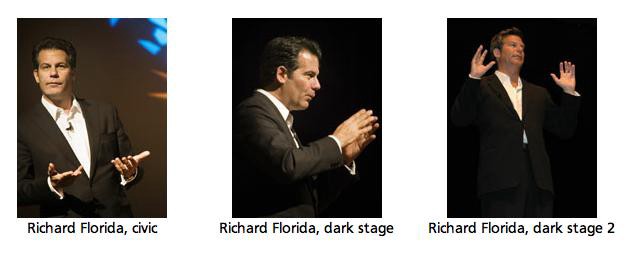
DARK STAGE 2: WRATH OF DARK STAGE
There's always money in the telling aspirational over-educated white people how important they are stand.
Does it even need to be said that Richard Florida is not to be taken seriously on the subject of city-/society-planning? At least show us the courtesy of naming yourself "Richard Maine."
@lawyergay It has always seemed to me like a horrible misallocation of name-capital that Dick Florida is peddling this particular line of snake oil, and not working as a professional gambler or maybe a stripper or something.
"Terrific?" Really? Ironically, that take down of Florida seemed to suffer from all the problems and liberty taking it accused Florida of. I mean, Florida might be wrong, sure, but is "I went there and in my very very very personal experience consisting of a few people I met, he's dead wrong" a good counter to "fake science and lies?"
What's more, this guy is basing all this experience on his profession as a writer? Yeah, I could have told you Madison was not a "hot bed" for writers to make tons of money and be flush with opportunity. But, then, where is that place? Was he a scientist? A graphic designer? A programmer? I think he seems to think by "creative class" Florida meant "artsists." But that isn;t exactly true.
@Abe Sauer To be fair to Bures, he did engage with a lot of academics who do empirical/statistical work that seems to refute some of Florida's foundational premises. And he does address Krätke's work, which disaggregates Florida's Creative Class and specifically acknowledges the special economic effects of “scientifically and technologically creative workers”. Certainly he uses his own experience as the narrative structure of the piece, but the basis for his conclusions is much broader and sounder.
@s. I get that. And again, I agree that Florida's work may be flawed, but having lived in both of the places, this core passage:
>"In the end, no amount of wishful thinking, either about ourselves or about Madison could change what it was: A giant suburb with a university in the middle. It wasn’t a bad place, and many people we knew loved it. But the fact was that we simply didn’t belong there. We didn’t have PhDs and had no connection to the university and didn’t work in government. And to live in a place where you don’t belong can begin to feel like a kind of nonexistence. So we sold our house, packed a truck, and headed to Minneapolis.
>This time, we moved as wiser, more reality-based people. We researched it carefully. We picked the place we wanted to live not because of any trendy trope, or because it was high on any particular list, but because of the cheap housing, jobs, family and friends, as well as the arts, the biking, the public transit and quality of life. Four years later, we’re happily ensconced. Why? I’ve quit trying to find easy answers to that question. Minnesota isn’t perfect, and I’m not going to pretend it is. But it’s good, and we like it, and it has begun to feel like a place where we belong."
It's as if he thinks these are different places when one is really just a baby version of the other. Sure, a writer will find a boatload more opportunity in Minneapolis b/c it's situated in a greater area that draws like 2 million, whereas Madison is a kind of island with a greater area population of like 300,000.
Speaking of the long arc, he should look at where Madison has been and where it's going vs. Minneapolis. Minneapolis for decades has had industry and 3M and Target and a ton of headquartered corporations that hire creative people. Madison for a long, long time really was just "A giant suburb with a university in the middle." But in the last few years, it has also begin attracting corporate HQs and such. To know Madison 20 years ago vs. today is astounding in terms of economic growth. I mean, what the hell is "public sector spending through the university" if not spending on creativity?
And then there is this:
>"Looking back, it was strangely liberating to have realized that the Creative Class was a myth. It was fun for a while and, unfounded as it was, a few good things may even have come out of it. Some cities built bike paths. Others poured money into their arts communities. I’m all for biking and the arts, as was everyone I spoke to for this story. In fact, they were at pains to point out that they were not opposed to the things Florida was advocating. “To be against this,” said Jamie Peck, “is like being against motherhood and apple pie. You’re against creativity? You’re against gays and lesbians?
>You’re against parks and bike paths?” Michele Hoyman echoed the sentiment. “There are a whole variety of reasons to have arts as a centerpiece of your city. One is to make it a tourist destination. Another is if you want to revitalize a neighborhood. Retail is fine as a revitalization strategy, but it doesn’t have a very good multiplier effect. It’s not going to save a city that’s completely dying.”
“Even as an arts advocate,” said Mel Gray, “I want to do it for the right reasons.” The right reason, we can now say, is that these things are good in themselves. They have intrinsic value. They make the place we live more interesting, livelier, healthier and more humane. They make it better.
>They do not make it more profitable."
Minneapolis was *(until very recently) the "gayest" city in America. It ranks #1 for bike paths and bikeability and it continues to invest heavily in being more bike able. It is extremely high in investment in the arts. The argument here seems to be that Minneapolis is NOT one of these places when in fact it might be the pinnacle "creative class" place where the presence of such a "creative class" has formed a kind of self-sustaining growth engine. It is this very reason many HR people and execs in the state are worried that November's vote to outlaw gay marriage could make the city less competitive against places like the Iowan triangle.
Anyway, doing those things–investing in the arts and building bike paths and gayness–maybe don't guarantee profitability but they can, in fact, quite literally, make a place more profitable.