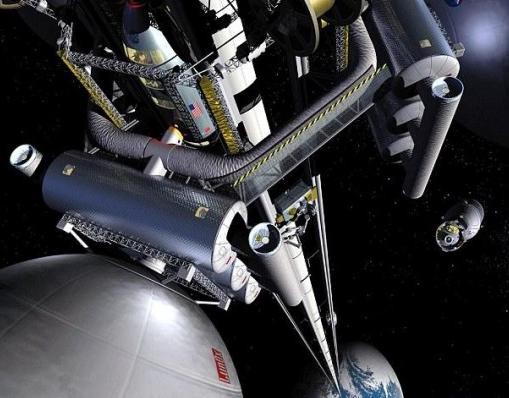
Didn't Alastair Reynolds have a whole thing about the innumerable disasters of a severed space elevator in one of his books? Like how it would basically collapse like a falling skyscraper, crushing everything beneath it?
@deepomega YES. I love that one. It's a central conceit in, I think, that endless trilogy. (SO ENDLESS.) I should collect all the space elevator scifi, it's all wonderful.
@deepomega Kim Stanley Robinson did it too in the Mars Trilogy, all in all it seems pretty nasty. I'm also wondering how much shielding they plan to load onto those cars for the multi-day journey through the Van Allen belts, cause radiation much?
@ejcsanfran OH GOD, they're all blurring together. My main problem is I've read every scifi book of the last 20 years so I have no idea which is which.
@ejcsanfran I was thinking of Chasm City, which has a space elevator feature prominently in the first act. Part of his confusingly ordered and endlessly growing Revelation Space trilogy/series/whatever.
@Choire Sicha Have you read "Absolution Gap"? If so, your relationship will become hate/kill. It it such a terrible book, it kind of goes back in time and soils the other (good to great) books in the Revelation Space series.
Last I heard, the "cable crash" thing only happens if you factor out air friction. The cable gets pretty wide at some points but not big enough that it won't burn up on reentry.
@brent_cox This is what I do not get about the "ooh so scary" reaction. The space shuttle has the shittiest safety record in the history of human transportation. IT EXPLODES HORRIBLY ONE IN EVERY 100 TIMES IT TAKES OFF.
Random thought: even when you hit zero-G, wouldn't the steady change in angular momentum mean you would actually start feeling gravity towards one of the walls? Or did my physics fail me here?
@Multiphasic : My admittedly-crappy memory of physics says that the constant change in angular momentum creates a centripetal force towards the center of rotation (ie, the Earth).
For the passenger in the space elevator, this translates to an apparent centrifugal force in the opposite direction, pulling them outwards along the line of the space elevator (a non-rotational-frame observer can chalk this all up to inertia). Think of swinging a bucket of water with a rope tied to the handle : the bucket is continually being pulled toward the center of rotation, and the bottom of the bucket exerts a force on the water in the same direction, toward the point of rotation. That's why you see the water uniformly spread over the bottom of the bucket, not up against one side. From the water's perspective, however, the force exerted by the bucket is away from the center of rotation (like "gravity" toward the bucket's bottom). I'm eliding a whole bunch of commentary about reaction forces and whether the centrifugal force is fictitious depending on the frame of reference, but whatever.
Anyway, at first the centrifugal force on the passenger is so small that it's overwhelmed by the gravitational force exerted by the Earth. As the passenger moves away from the Earth, the gravitational force exerted by the Earth decreases proportional to the square of the height. Since we assume the rotational period of the space elevator remains constant, the centrifugal force pulling the passenger away from the Earth increases proportional to the height. At some point on the elevator the two forces will cancel eachother out, and the passenger will have a net external force of zero. Your passenger is now weightless and can float around the cab.
Past that point, the centrifugal force exceeds the gravitational force, so the net force on the passenger is positive and directed away from the Earth (like the water in the bucket). In other words, you'd start out your journey standing on the floor of the cab, gradually get more and more weightless until you were floating in zero-G, and then start "falling" toward the "ceiling" of the cab with increasing Gs until you were standing on the former ceiling. No sticking to walls needed.
@Gef the Talking Mongoose Would the same "falling towards the ceiling" happen to a satellite (or space station) in geosynchronous orbit (assuming the orbit is past the point where the centrifugal/gravitational forces cancel each other out)?
@Gef the Talking Mongoose : Oh my god, will you be my new best friend? Seriously, just come hang out at my house and talk about sciencey things. I make really good fancy hors d'oeuvres, and I can teach you to play bridge or something?
@brent_cox : Yes, it would! Here is an explanation that any diligent physics professor would be able to give in probably half the space with twice the rigor (cough, cough).
A little groundwork first : Any satellite in geosynchronous orbit must be constantly adjusting its velocity to stay the same distance above the Earth. By "adjusting its velocity," I mean "changing the direction of its motion but keeping its speed constant." In other words, the satellite has to make sure that its direction of motion is always perpendicular to a line drawn to the center of the Earth. You sort of have to visualize this one : the direction of motion at any specific time is perpendicular to that radial line, but it's constantly changing as the satellite rotates because that radial line is rotating too.
Incidentally, that's exactly what the bucket-on-a-rope does : first, you get the bucket up to speed, but after that point you just maintain a constant speed and the rope makes the bucket's speed constantly change direction (a constant speed + changing direction = changing velocity = acceleration toward the center of the orbit = centripetal force, the reaction to which is the apparent "sticking to the ceiling" force). If you let the rope go, the bucket would fly off at a constant speed in a direction perpendicular to the line of the taut rope at the moment you let go (affected, of course, by any other forces around like the gravity of the Earth you're standing on while you do this bucket experiment).
OK, so all that said, when we're far enough away from the Earth, the Earth's gravitational force is overwhelmed by the force exerted by the satellite constantly changing the direction of its constant speed to keep itself in orbit. This force gets pretty large as we get that far out, since the linear speed of the satellite has to be really high to keep up with the rotation of the Earth (we're trying to stay in geosynchronous orbit, remember?). Geosynchronous satellites outside the point where gravitational / centrifugal forces balance (about 22,000 miles from Earth's surface) would have to provide that force themselves, with rockets or the like -- the force from those rockets, pushing the satellite toward the Earth, would create an apparent "falling toward the ceiling" force on anyone inside the satellite. Again, that force is entirely due to the changing -direction- of its velocity, not any increase in speed. The space elevator gets this force for free because it's rooted in the Earth ... its only problem is making sure the massive stresses involved don't tear it apart (ie, the rope attached to that particular bucket has to be incredibly strong for its size).
SPECIAL BONUS SECTION :
So why don't geosynchronous satellites have rockets and use up a massive amount of energy keeping themselve in orbit? Because we put them at just the right "zero-G" distance from Earth! There's really only three variables here : height from the Earth, force needed to keep the satellite's speed pointed in the correct direction, and the speed at which the satellite rotates. By specifying that our satellite must be geosynchronous, we're basically fixing the speed at which it has to rotate : it's got to be just enough to keep up with the Earth's rotation. We need a force that constantly drags the satellite downward toward the Earth, thus changing the direction of its motion to keep it in orbit, and we don't want to provide any of that force ourselves. Well, the Earth has exactly that type of force -- its gravitational field, which varies depending on how far away you are. So we pick the exact distance from the Earth at which its gravitational force is just enough to provide the necessary centripetal force on the satellite and voila -- we only have to contribute power to get the satellite up to the correct speed at the right altitude and don't have to spend any power to maintain its orbit!
@collier : If you take into account the fact that I'm probably wrong in some fundamental way about all this and that card games more complicated than gin rummy are Kryptonite for my brain, you got a deal.
@the teeth: You know that frisson of pleasure you get when you're on the elevator and the door shuts in the face of one of your arch-nemeses at the office as you're discreetly but repeatedly pressing the "close door" button? Imagine that same feeling knowing that he'll have to wait 16 DAYS for the next elevator.
What we need is a space escalator, like in that one Tom & Jerry cartoon where Tom dies and rides an incredible glowing art deco escalator up to the pearly gates.
@DoctorDisaster yes. That price tag is... pretty optimistic. And in any case we're not even close to having the technology needed to build one. The only material with the necessary strength:weight ratio would be the fabled carbon nanotube... and we'd need to be able to fabricate these in lengths on the order of meters to make this work. Right now we're doing good if we can make one a millimeter long.
The other big obstacle is economic: you spend all this money on a space elevator... and recover your costs how? So far every "plan" I've seen for a space elevator might as well have been written by the underpants gnomes.
I think it would be funny if they ran the first car up and it lost its erection halfway through and then I guess there would be a catastrophe as has never before happened to Earth?
Didn't Alastair Reynolds have a whole thing about the innumerable disasters of a severed space elevator in one of his books? Like how it would basically collapse like a falling skyscraper, crushing everything beneath it?
@deepomega Nothing brings people together like a 60,000 mile cable cutting them in half.
@deepomega YES. I love that one. It's a central conceit in, I think, that endless trilogy. (SO ENDLESS.) I should collect all the space elevator scifi, it's all wonderful.
@deepomega Kim Stanley Robinson did it too in the Mars Trilogy, all in all it seems pretty nasty. I'm also wondering how much shielding they plan to load onto those cars for the multi-day journey through the Van Allen belts, cause radiation much?
@boysplz LET'S MAKE OUT.
@Choire Sicha: Which book please?
@ejcsanfran OH GOD, they're all blurring together. My main problem is I've read every scifi book of the last 20 years so I have no idea which is which.
@ejcsanfran I was thinking of Chasm City, which has a space elevator feature prominently in the first act. Part of his confusingly ordered and endlessly growing Revelation Space trilogy/series/whatever.
@boysplz Van Allen belts? Nothing that a little Starfish Prime action can't resolve.
@deepomega YES. Chasm City. Oh god, I have such a love/hate thing with him.
@Choire Sicha Have you read "Absolution Gap"? If so, your relationship will become hate/kill. It it such a terrible book, it kind of goes back in time and soils the other (good to great) books in the Revelation Space series.
@riotnrrd YES. THAT'S THE ONE THAT DID ME IN. The book is like... it, yes, TIME STOPPED. I think I actually put it down, and I NEVER put books down.
Last I heard, the "cable crash" thing only happens if you factor out air friction. The cable gets pretty wide at some points but not big enough that it won't burn up on reentry.
Six billion dollars SOUNDS like a lot, but if they can leave the Kickstarter project open for pledges until, like, 2040, it's really not that bad.
Why can't they just perch themselves atop a building-sized canister of chemical explosive and then light the fuse like everyone else?
@brent_cox This is what I do not get about the "ooh so scary" reaction. The space shuttle has the shittiest safety record in the history of human transportation. IT EXPLODES HORRIBLY ONE IN EVERY 100 TIMES IT TAKES OFF.
You think elevators in space are dangerous? Try elevators in NYC.
Random thought: even when you hit zero-G, wouldn't the steady change in angular momentum mean you would actually start feeling gravity towards one of the walls? Or did my physics fail me here?
@Multiphasic I believe this is addressed in Adam-Troy Castro's ANDREA CORT books.
@Multiphasic : My admittedly-crappy memory of physics says that the constant change in angular momentum creates a centripetal force towards the center of rotation (ie, the Earth).
For the passenger in the space elevator, this translates to an apparent centrifugal force in the opposite direction, pulling them outwards along the line of the space elevator (a non-rotational-frame observer can chalk this all up to inertia). Think of swinging a bucket of water with a rope tied to the handle : the bucket is continually being pulled toward the center of rotation, and the bottom of the bucket exerts a force on the water in the same direction, toward the point of rotation. That's why you see the water uniformly spread over the bottom of the bucket, not up against one side. From the water's perspective, however, the force exerted by the bucket is away from the center of rotation (like "gravity" toward the bucket's bottom). I'm eliding a whole bunch of commentary about reaction forces and whether the centrifugal force is fictitious depending on the frame of reference, but whatever.
Anyway, at first the centrifugal force on the passenger is so small that it's overwhelmed by the gravitational force exerted by the Earth. As the passenger moves away from the Earth, the gravitational force exerted by the Earth decreases proportional to the square of the height. Since we assume the rotational period of the space elevator remains constant, the centrifugal force pulling the passenger away from the Earth increases proportional to the height. At some point on the elevator the two forces will cancel eachother out, and the passenger will have a net external force of zero. Your passenger is now weightless and can float around the cab.
Past that point, the centrifugal force exceeds the gravitational force, so the net force on the passenger is positive and directed away from the Earth (like the water in the bucket). In other words, you'd start out your journey standing on the floor of the cab, gradually get more and more weightless until you were floating in zero-G, and then start "falling" toward the "ceiling" of the cab with increasing Gs until you were standing on the former ceiling. No sticking to walls needed.
@Gef the Talking Mongoose Would the same "falling towards the ceiling" happen to a satellite (or space station) in geosynchronous orbit (assuming the orbit is past the point where the centrifugal/gravitational forces cancel each other out)?
@Gef the Talking Mongoose : Oh my god, will you be my new best friend? Seriously, just come hang out at my house and talk about sciencey things. I make really good fancy hors d'oeuvres, and I can teach you to play bridge or something?
@collier TOO LATE, GEF IS MY BEST FRIEND FIRST.
@brent_cox : Yes, it would! Here is an explanation that any diligent physics professor would be able to give in probably half the space with twice the rigor (cough, cough).
A little groundwork first : Any satellite in geosynchronous orbit must be constantly adjusting its velocity to stay the same distance above the Earth. By "adjusting its velocity," I mean "changing the direction of its motion but keeping its speed constant." In other words, the satellite has to make sure that its direction of motion is always perpendicular to a line drawn to the center of the Earth. You sort of have to visualize this one : the direction of motion at any specific time is perpendicular to that radial line, but it's constantly changing as the satellite rotates because that radial line is rotating too.
Incidentally, that's exactly what the bucket-on-a-rope does : first, you get the bucket up to speed, but after that point you just maintain a constant speed and the rope makes the bucket's speed constantly change direction (a constant speed + changing direction = changing velocity = acceleration toward the center of the orbit = centripetal force, the reaction to which is the apparent "sticking to the ceiling" force). If you let the rope go, the bucket would fly off at a constant speed in a direction perpendicular to the line of the taut rope at the moment you let go (affected, of course, by any other forces around like the gravity of the Earth you're standing on while you do this bucket experiment).
OK, so all that said, when we're far enough away from the Earth, the Earth's gravitational force is overwhelmed by the force exerted by the satellite constantly changing the direction of its constant speed to keep itself in orbit. This force gets pretty large as we get that far out, since the linear speed of the satellite has to be really high to keep up with the rotation of the Earth (we're trying to stay in geosynchronous orbit, remember?). Geosynchronous satellites outside the point where gravitational / centrifugal forces balance (about 22,000 miles from Earth's surface) would have to provide that force themselves, with rockets or the like -- the force from those rockets, pushing the satellite toward the Earth, would create an apparent "falling toward the ceiling" force on anyone inside the satellite. Again, that force is entirely due to the changing -direction- of its velocity, not any increase in speed. The space elevator gets this force for free because it's rooted in the Earth ... its only problem is making sure the massive stresses involved don't tear it apart (ie, the rope attached to that particular bucket has to be incredibly strong for its size).
SPECIAL BONUS SECTION :
So why don't geosynchronous satellites have rockets and use up a massive amount of energy keeping themselve in orbit? Because we put them at just the right "zero-G" distance from Earth! There's really only three variables here : height from the Earth, force needed to keep the satellite's speed pointed in the correct direction, and the speed at which the satellite rotates. By specifying that our satellite must be geosynchronous, we're basically fixing the speed at which it has to rotate : it's got to be just enough to keep up with the Earth's rotation. We need a force that constantly drags the satellite downward toward the Earth, thus changing the direction of its motion to keep it in orbit, and we don't want to provide any of that force ourselves. Well, the Earth has exactly that type of force -- its gravitational field, which varies depending on how far away you are. So we pick the exact distance from the Earth at which its gravitational force is just enough to provide the necessary centripetal force on the satellite and voila -- we only have to contribute power to get the satellite up to the correct speed at the right altitude and don't have to spend any power to maintain its orbit!
@collier : If you take into account the fact that I'm probably wrong in some fundamental way about all this and that card games more complicated than gin rummy are Kryptonite for my brain, you got a deal.
Isn't that just a South Park bit?
They say the trip will only take eight days, but that's before some asshole gets on and pushes all the buttons for the lower floors.
@Astigmatism: "You're only going to the stratosphere? God forbid you should take the stairs... Jesus, some people."
show me a man who doesn't love space elevators and I'll show you a man who doesn't love life.
You could really perfect your elevator pitch though.
2. Lightning conduit.
3. Space Elevator Music.
4. Godzilla magnet.
5. "Shaft" jokes
6. Nanotuberculosis
7. Space LIFT. #knifecrimeisland
@ejcsanfran NanotuberculOTIS.
8. No wifi, WTF
9. Giant at the top will grind your bones to make his bread
10. Wonkavator collision.
Paging Tyler Coates
Totally fair, but I'd be thrilled if you followed that with a short list of things that are totally AWESOME about space elevators.
@the teeth Um, those little bags of honey roasted peanuts they give you?
@the teeth: You know that frisson of pleasure you get when you're on the elevator and the door shuts in the face of one of your arch-nemeses at the office as you're discreetly but repeatedly pressing the "close door" button? Imagine that same feeling knowing that he'll have to wait 16 DAYS for the next elevator.
What we need is a space escalator, like in that one Tom & Jerry cartoon where Tom dies and rides an incredible glowing art deco escalator up to the pearly gates.
@Leon Tchotchke : I'm still holding out for a Space Trebuchet.
WAIT A MINUTE.
"There is one small problem – the space elevator could cost over $9.5 billion."
First: The price tag is pretty much the LEAST of the obstacles for the space elevator. I LOVE YOU, space elevator, but we all know it's true.
Second: NINE POINT FIVE BILLION DOLLARS? ARE YOU SHITTING ME? WE COULD HAVE GOTTEN SEVENTY-SEVEN SPACE ELEVATORS AND INSTEAD WE BOUGHT BANKS???
@DoctorDisaster yes. That price tag is... pretty optimistic. And in any case we're not even close to having the technology needed to build one. The only material with the necessary strength:weight ratio would be the fabled carbon nanotube... and we'd need to be able to fabricate these in lengths on the order of meters to make this work. Right now we're doing good if we can make one a millimeter long.
The other big obstacle is economic: you spend all this money on a space elevator... and recover your costs how? So far every "plan" I've seen for a space elevator might as well have been written by the underpants gnomes.
I think it would be funny if they ran the first car up and it lost its erection halfway through and then I guess there would be a catastrophe as has never before happened to Earth?