Facebook as a Threat to Storytelling
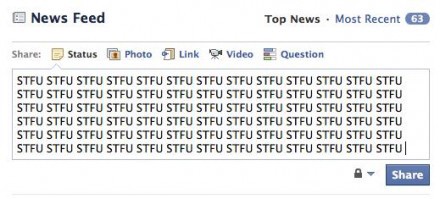
Here's a good question: what if the discomfort expressed, on different fronts and with rationales, by the Malcolm Gladwells and Bill Kellers and the Zadie Smiths and whoever else hates the Face-Twitters now, was mostly just a love of (or addiction to?) narrative? Facebook stories don't really have any endings, and neither do they always have multiple conflicting sources (not like the newspapers have much of that either anyway). "At the end of every magazine article, before the "■," is the quote from the general in Afghanistan that ties everything together. The evening news segment concludes by showing the secretary of State getting back onto her helicopter. There's the kiss, the kicker, the snappy comeback, the defused bomb. The Epiphanator transmits them all. It promises that things are orderly. It insists that life makes sense, that there is an underlying logic." Newspapers, magazines and procedurals are the last forms hanging on to tidy endings. The rest of us are just, like, living here.


Who the hell gave you the glogin back?
I don't know, this "Epiphanator" sure churns out a fucking lot of serial media that people won't let die.
I don't like neat narratives or twitter but I loves me the Facebook. Make sense out of that, media!
Also worth mentioning.
Ridiculous. Narratives have to have endings? Every story dies a thousand deaths in its time, and if you can't figure out where to put the chapter breaks then maybe your problem with serial real-time storytelling is a failure of imagination.
@deepomega You could say "traditional" narrative if it makes you feel better, but the narrative without a conclusion is an incredibly recent invention. Comic books and TV and before that… what?
@deepomega: Well, in modern times, I'd throw radio serials onto the stack, and serial novels/pulp stories like Alan Quatermain and what have you. But it gets easier the farther back before Gutenberg we go. What was One Thousand and One Nights? What was The Odyssey? Oral tradition has a lot to say about ongoing storytelling. I think the idea that a story has a start and an end, not too far from each other and with a predetermined purpose and outcome, is the newer invention.
@deepomega: I feel like the Odyssey did have an end, and a pretty clearly marked one. Odysseus wants to get home. And then Odysseus gets home. (I think one could make a case for One Thousand and One Nights, too.)
@Moff: Yeah I mean, I don't think the problem posed by DD above is necessarily one of conclusion. Comics and tv shows end all the time! It's one of planned conclusion – of an organized ending which was conceived of at the same time as the beginning. A novel has an organized start and end which, presumably, the author wrote to fit together. A tv show spans years and usually authors, as do comics, and Homeric epics, and the collected One Thousand and One Night. So while the Odyssey ends, its ending is just the last story told. Like a series finale. Or like someone on facebook writing a last status update saying that they are leaving facebook forever.
@deepomega: Oh, that makes sense. Yes, I would say you are right that the planned narrative is newer.
@deepomega Still disagree! The Odyssey may have expanded and changed as different authors got a hold of it, but the first version contained a beginning and an end. One Thousand and One Nights is simply a compilation of existing unrelated folk tales, each of which had a clear beginning and end, using a framing device that also had a beginning and end from the get-go. (It's also decidedly a document of an oral tradition rather than a part of one.)
I think it's also important to distinguish between sequels, traditional serials, and a modern infinite serial. Anansi may have appeared in a zillion stories, but each one was a self-contained, unplanned sequel. People just kept reusing the character. Something like a Dickens novel would be a traditional serial, where an author milks the plot as long as he bloody can because that's how he puts food on the table, but it still has a clear, story-driven conclusion, after which he gets to work on a new story.
The infinite serial, which is the only thing that corresponds to facebook, is a situation where you introduce a bunch of characters with the intention of regularly updating their story in non-self-contained chunks until circumstance forces you to stop. Infinite serials may contain arcs, but they are never all resolved at once; there is always a plate or two spinning in the ongoing story. These are your Doctor Whos and your Spider-Mans and also your twitter feeds. You can kind of tell they're new anyway because of the ridiculous storytelling devices (think "Crisis," comics fans) we've had to invent to keep them going.
This reminds me of Joan Didion's "The White Album," the essay about her nervous breakdown. In it she basically says her anxiety during that time was all about realizing there is no narrative, that nothing fits neatly into a story. This was written in response to the chaos of the 60s, of course, but seems like what you're saying here – and I agree, I think – is that the chaos of the Internet is making people (old ones, mostly) uncomfortable in the same way.
@Jane Donuts@twitter Why is it you think "mostly" old people are made uncomfortable by the "chaos of the Internet"? I'm old and I'm mostly made uncomfortable (oh, well, pissed off really, not uncomfortable) by ageism and other lazy stereotyping.
@Jackie Thomason Yeah, you're right, it was kind of an ageist remark. But uh, you don't see a lot of young people being uncomfortable with the massive transformation in the way content is disseminated and shared – it's the world they've grown up in.
BUt I didn't say all old people are worried about this change. And I'm sure some young people are uncomfortable with it too. I'm somewhere in the middle and I struggle to process it all.
@Jackie Thomason Ummm… because it's true? Here's a hint: Various "-isms" and stereotyping are when you discriminate against someone based on characteristics they can't change, or assign to an entire group qualities that are thought to be derogatory. Saying that most of the people uncomfortable with the internet are old is about like saying most Americans with dark skin have African ancestry. Sure, there are some that are South Asian, some that are Melanesian – hence "most". But saying this is neither racism nor stereotyping – it's simple demographics.
Friend me, Muse, and through me update a news feed
of that man skilled in all ways of contending,
the wanderer, harrying us for years,
blathering on about his status unending.
@BadUncle I like it when the guy finishes on her breasts.
@saythatscool It's epic, d000d.
If by narrative you mean wanting to take some time off from shopping, then yeah.
This little piggie went to market. The others died in a fire. And I love bacon.
I'd totally post this on my Wall if I ever bothered to join Facebook. Hmm, a Facebook account devoted to negative publicity about Facebook…but I can't imagine those smug little privacy invaders would allow that to stand for long. Maybe on Google +…
If your narrative is neat and/or tidy, you're not a very good journalist or novelist. Just, you know, sayin'.
I don't even own a Facebook.
@whizzard I have one in white gold.
Can there just be a PAUL FORD SPEAKS TRUTH slug for situations like these? It's the second time in the past week!
This is a serious question: But ought one attempt to shape one's life into a narrative?
And if one ought to, is that a valid reason to be discomforted by (if not absolutely opposed to) the decline of narrative?
Narrative is a beautiful word that stands in for so many concepts it gets a little punch drunk. At the moment it is bringing us perilously close to a dorm room bull session on destiny and free will.
I will then rephrase the question: Do I have the right to use any cognitive tool necessary to make sense of my life and life in general?
In my experience, the question do I have a valid reason to feel this way is not very comforting, not at first anyway. But anyone probably needs to ask it now and again, along with either your version of the bigger question or mine.
@Moff A serious answer … In Portrait of a Lady, which is really all about choosing a narrative, the "villain" tells the heroine that she should make her life a work of art, and she marries him and becomes his prisoner, essentially. She mistook form for freedom. Point is … isn't our life a narrative whether we like it or not? We can choose the genre to some extent, but there's only so much shaping we get to do. (I think this kind of relates to that nostalgia post from the other day.)
Nice crypto-non-kicker kicker!