
London's Student Demonstrations Are the Best Sort of Education
by Dan Glaun
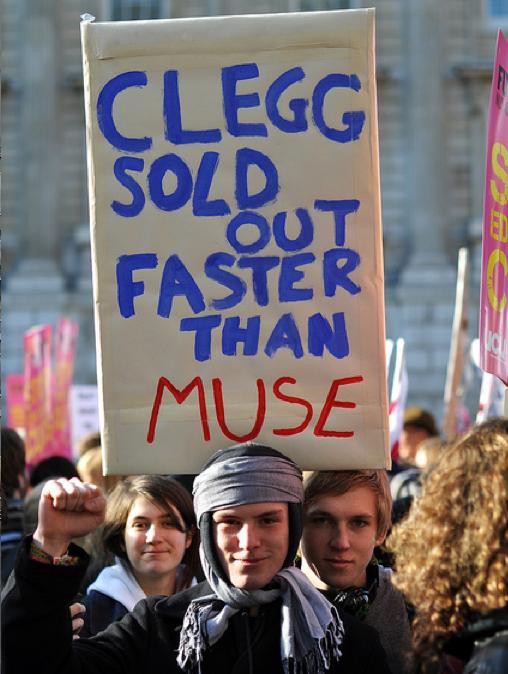
Earlier this month, students across the UK began protesting against planned increases in tuition fees and the cutting of university services. Today, students have been occupying buildings in Birmingham and hurling snowballs in Edinburgh and marching in London. All of this thoughtful demonstrating — which is winding down in arrests and some clubbings and the offering of mince pies to politicians — takes place against the dramatic backdrop of the first demonstrations on November 10th, when tens of thousands of young people stormed London. At the end, in Millbank, in central London, some demonstrators smashed windows; fires were set; and an occupation of Conservative headquarters by a few hundred ensued (from that building, an 18-year-old threw a fire extinguisher off the roof). Further, the second wave of demonstrations, on November 24, went off with some hitches when some small violence against property ensued and the police cornered and arrested a number of marchers.
The media refers to both the November 10th and November 24th demonstrations as “riots.” (“As Students Rampage…,” headlined the Mirror last week.) So what is becoming lost is what the November 10th demonstration was like for the 30,000 to 50,000 peaceful protesters who flooded the streets outside Parliament in defense of higher education.
My protest experience began at the ungodly hour of 7:30 a.m. in a University of Sussex campus bar. It was serving breakfast early for the occasion. The warm-enough eggs and triangular slabs of hash browns were just one aspect of the institutional support for the demonstration — professors were encouraged to reschedule lectures to allow attendance, and assignment due dates were pushed back a day. The Sussex Student Union had found common cause with an administration seemingly eager to regain students’ good will and stave off government cuts.
In a burst of journalistic arrogance I approached a student sitting intent over his eggs and toast and asked if he’d mind answering some questions. He said that he didn’t mind, his name was Bart, and he was Dutch, in that order; when asked why he was demonstrating for another country’s education system, he replied that it was a matter of social responsibility — and a misconception on the state’s part of what education is: “Basically, you have to pay for your own education because you are the only one profiting from it. And that’s just not true.” Common benefit should equal common cost — as morally clear a belief as any, and one directly contradicted by the reasoning of the Browne education review and David Cameron’s governing coalition.
The Browne review is the polarizing document from David Cameron’s government — which was actually commissioned by Gordon Brown on the way out — in order to reduce Britain’s growing national deficits. You may read it here. The summary explains that Lord Browne’s “recommendations present a radical plan to shake up higher education in England and a charter for choice for students.” The review is now a component of Cameron’s deficit reduction scheme which contains, among various policy suggestions, cuts to social programs, welfare, government payrolls and defense. The most controversial recommendations so far — at least the only ones to inspire tens of thousands to wave signs and yell slogans from the National Gallery to Millibank — are the ones to do with the Browne report. Britain’s higher education system, a bedrock of the welfare state since the 1962 Education Act mandated free university for all, has been steadily eroded since Tony Blair’s Labour administration instituted fees in 1998.
Since then, fee limits increased from £1500 to £3000, as the government tried to shift the funding of universities from grants to tuition. The Browne review would raise that limit to £9,000, as well as eliminating all government funds for the humanities. This has sparked what can only be labeled a shitstorm among students, many of whom voted for Nick Clegg’s Liberal Democrats only to see the party abandon their anti-fees pledge upon forming a coalition with the Conservatives.
Given that us American college students — I am an exchange student — regularly face tuitions of up to $50,000 each year to go to school, the outrage here can have a surreal tinge to it. Then again, we expect our schools to treat us like consumers. In fact, the new buzzword in higher education has administrators calling students “customers.”
I filed into line after breakfast and received a recycled wristband (it was labeled “Sussex Fresher’s Pub Crawl”) to gain access to the coach. The bus filled up quickly and left. Students talked animatedly, hands around cardboard cups of coffee, or leaned their heads against windows and tried to sleep. A tall, pale kid in a hoodie walked the length of the double decker, hawking copies of Socialist Worker; a group of three unnaturally peppy girls carried a large tupperware container of flapjacks, selling them for some cause or another. Luke, a first year student with the red of a Remembrance Day poppy on his blazer, sat next to me. For him, the demonstration was a personal as well as political matter — while he would be out of university before the fees came into effect, his younger brother would have to face the choice of heavy debt or lack of education.
The drive stretched north through miles of English suburbia and countryside. The low November sun bathed the coach and formed shifting, fractal shadows against the encroaching treeline. A black, tapered structure appeared out of the passing fields — a World War II monument, small wooden crosses and poppies arranged next to it in rows. The traffic grew torturous as we passed through the outskirts of London — Coulsdon, Norbury, and Streatham crawling by in repetitious streets of barber shops, Halal restaurants, convenience stores, and one incongruous Papa Johns. Repurposed factories that were now shops littered side streets, defunct smokestacks angled up to the cold blue sky. A banner outside the Stockwell underground station memorialized Jean Charles de Menezes, an innocent man shot dead in 2005 by police who believed him to be a terrorist responsible for the recent London tube bombings.
We eventually made it into London proper, disembarked at the Aldwych Theater, and began to walk to the London School of Economics. Along the way I talked to students. Ellen, a Sussex undergraduate, said that she was marching for her younger sister, while Adam, a student in a pseudo-military getup carrying a sign over his shoulder, was at his first major protest. The commonalities were striking — a lack of major political experience, a feeling of betrayal on the part of Nick Clegg and the Liberal Democrats, and a sense of moral outrage over the government’s abdication of social responsibility.
We crossed the Thames, our numbers growing as demonstrators converged on the rally point. The crowd was vocal throughout, shouting, singing, generally making a high spirited racket. The chants ranged from the traditional — “No ifs, no buts, no education cuts,” a classic of iambic outrage — to the hilariously blunt. Class was a clear dividing point. Shouts of “David Cameron, go back to Eton” were greeted with raucous cheers. Easily the best, however, was a tuneful chant set to “Oh My Darling, Clementine”:
Build a bonfire, build a bonfire
Put the Tories on the top
Put the Liberals in the middle
And we’ll burn the fucking lot.
In retrospect, that reads as some very on the nose foreshadowing for what was to come at Tory headquarters. At the time, however, I chalked it up to an endearing pyromaniac tendency in British politics, coming as it did just five days after the fireworks and effigies of Guy Fawkes Day.
We crowded into a wide alley between the brick and concrete buildings of the London School of Economics, the crowd filing in behind us. Signs dangled from ceilings and windows; a huge blue and green banner saying “Freeze the Fees” was strung from the window of a high rise directly in front of the rally. LSE students and lecturers delivered a series of short, punchy speeches, hitting notes of anger, populism and social justice. A professor shouted his deep sandpaper brogue into a microphone, attacking the “fat cats” who have “wrecked our society,” asking the crowd if any of them were going to go work for Goldman Sachs (he was met with a chorus of boos). “We will not stand idly by while politicians sell our education to the highest bidder,” said one student representative during an impassioned plea for public education and the humanities. The crowd was young and thoroughly multi-ethnic; most carried backpacks. Many took the opportunity to roll cigarettes while standing still.
Then the speeches were over, and with a collective roar the demonstration began its march to Parliament. One student lit a red sparkler and ran through the crowd, trailing smoke and embers behind him. The march grew in size as more protesters streamed in from side streets and were greeted with cheers. With surprising quickness the demonstration’s numbers grew from the thousands to the tens of thousands. Bemused tourists waited endlessly to cross the street as we cut through Trafalgar Square; cars and trucks that honked in solidarity received roars of approval. Bursts of music mixed with the general exuberant volume of the students. A drumline beat a rhythm outside Pizza Express. A brass band reading sheet music taped to each others’ backs played John Philip Sousa’s “The Liberty Bell” march — more commonly known as the Monty Python theme song. An enterprising street vender sold vuvuzelas to the walking masses.
As the demonstration made its ponderous way down Whitehall, I spoke with several protesters about their reasons for demonstrating. Rob, a student new to political action, characterized the proposed fee raises as “just stupid, really.” Trying to draw out a slightly more trenchant analysis of the situation, I asked who he had voted for in the last election and hit the sore spot. Rob had voted Lib Dem, and thought it was “horrific how that they’ve turned against us and fucked everything up.”
Polly, a mother of one future and two current university students, was demonstrating with a sign reading “Angry Mums against Higher Uni Fees.” While there was no visible evidence of widespread maternal radicalism, she assured me that there were many like her out there. A Labour voter, she nonetheless expressed outrage at the Liberal betrayal and thought that Nick Clegg should do the decent thing and step down.
And I met Sam, a long-haired Goldsmiths student, standing on the balustrade outside Her Majesty’s Revenue and Customs building. He had voted Green, and felt vindicated. “I was never going to vote Lib Dems,” he said. “It was obvious from the beginning that they were between a rock and hard place, between Labour and Conservatives, and they’re both bullshit. To be fair to them, that’s what they do. They’re in Parliament.”
The march slowed to a crawl as police held open half the road. After twenty minutes of excessively slow movement, I cut through a traffic jam and jogged down the sidewalk looking for a better view. After climbing on a guard rail, I discovered that the demo had grown staggeringly huge — media estimates placed the top number at around 50,000, but all I knew then was that Whitehall was shoulder to shoulder with students from Trafalgar Square down to Parliament. Finally the rally picked up speed again; the streets were full as it reached its endpoint, thousands upon thousands surrounding Parliament, a student with a camera hanging one-armed off the Westminster station underground sign. There were drums and the constant din of human voices, rising to frantic pitch after each round of cheers or in response to anything, really. A circling news helicopter drew excited mass yells each time it passed over the demonstration. Until then, the protest had seen very limited police presence and, according to one officer I spoke to, had been completely peaceful.
As we walked past Parliament, a woman with a megaphone informed us that the official demonstration was over. Word started to spread of a thoroughly unofficial occupation of Tory headquarters that was taking place a few blocks down the street. That building was a scene of sublimated chaos. A crowd of demonstrators stood on the street outside, steadfastly ignoring pink-vested officials urging them to move along. Inside the semi-circular courtyard, hundreds of students were jammed together as smoke rose from an improvised bonfire and drum-and-bass blasted out of speakers from a staircase. Up on the roof, several occupiers pumped their fists and waved black and red flags to yells of solidarity from the crowd. A University of Leeds banner was hung from the top of the facade to cheers.
The crowd was packed thick and I couldn’t see much, so I jumped a guardrail onto a more sparsely populated stairwell. The entire front window had been smashed; the glass was a spiderweb of cracks, with shards scattered on the walkway leading to the entrance. A line of police officers, ludicrously outnumbered, formed a barricade around the doorway as a spontaneous mosh pit formed fewer than twenty feet from them. A line of riot police carrying batons and plexiglass shields tried to push their way to the door; they retreated after being pelted with sticks from signs and shoved back. A group of demonstrators broke a boom barrier and began to stream around the back of the building, where a few police officers stood guard over Tory headquarters’ parking garage.
A few students were starting another fire on the outskirts of the courtyard, using broken signs and copies of the Socialist Worker for kindling. I walked towards Whitehall. I saw a small group of students blockading a side street, where police reinforcements stood uncertainly and then left. Tom, a protester in a black knit cap carrying a megaphone, said that they’d been blocking the route for around fifteen minutes, and generally demonstrating in the area for a couple of hours. I asked him what he thought about the police retreat: “At the moment the police force here are spread fairly thin,” he said. “They seem to be jumping to different areas of the vicinity, so I imagine they’ll be coming back here as soon as more people start throwing things again.”
If that situation reads like the adolescent fantasy of a kid who just bought his first Dead Kennedys album and feels like it really means something, well, it kind of was. Youths waving banners from the top of a damaged government building, seemingly immune to the police or the vagaries of any authority — it was powerful, and I did get swept up in the mass exhilaration. The slightest moment’s reflection, however, reveals the short sightedness of the violence. For instance, the political consequences to a movement that needs mainstream support to affect national policy, or say, the stupidly dangerous decision to throw a fire extinguisher out an office window with hundreds of people standing below.
The occupation cannot be viewed as defining the protest as whole, or as being separate from it. Given that the two most recent mass demonstrations in the United States were run by a TV comedian and a reactionary demagogue, also from TV, the events of November 10th deserve our respect. They displayed extremity in the form of an articulate, outraged, passionate response to government abandonment of education that drew tens of thousands of committed young people off the Internet, out of the schools and into the streets.
Correction: This post has been updated in one paragraph to properly explain the Browne Review.
Dan Glaun is a UMass undergrad and thinks you’re pretty cool. He is currently unemployed, but prefers the term ‘freelancer.’ He can be reached at dgg20 [AT] sussex.ac.uk.
Photo by Andrew Moss from Flickr.