
Case Studies in Successful Self-Publishing: "To Slow Down the Time"
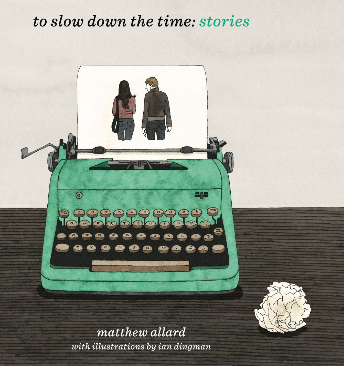
To Slow Down The Time is an illustrated collection of short stories, written by Matthew Allard. Each of the stories was inspired by an illustration by Ian Dingman, who works widely as a professional illustrator and as a fine artist. The book was produced in two editions. The first was a hand-bound limited edition of 100 books, priced at $35 each. That edition sold out in a week, and a paperback print-on-demand edition was created.
After reviewing costs and quality, CreateSpace, Amazon's publishing arm, was selected. (Other comparable companies have jacked up their small-run print-on-demand rates in the last six months.) The paperback is full-color, 8.5" square, and because of that sells for $19.99. There is also a digital edition priced at $9.99. (The book design and the accompanying website were donated by an experienced friend of the author's.)
The project is extra-complicated for a print-on-demand project, due to the color illustrations and for the hand-made edition. If the book were black and white, profits would have tripled-but then also, it would surely lack some of the buyer interest.
The paperback is also sold on consignment at a few independent bookstores. The trick with POD and consignment is, well, you have to have printed some, you see.
"We made money. I had no expectations for what would happen," Allard wrote in response to questions. "I just wanted to be able to say, 'Look what I worked hard on; I think it's neat.' But, there was interest and support." He noted that the book was purchased by strangers. The magic of the Internet! "The pre-order was smart in hindsight, especially with POD," he wrote. "I didn't spend a dime up front on the project…. I used the pre-order money to print an initial round of books that I'd already sold, plus a few extra, and turned some of them into hardcovers."
Such a product isn't going to provide a living, quit-your-job salary-not necessarily, or right away. But the benefits include near-immediate gratification and personal investment in the book as a business entity, both things that traditional publishing alienates authors from. "I was making something and I didn't want to wait for someone to tell me that I *could* make something," Allard wrote. "I made money right away. It's not a 'salary' and I still have to work. But it's money to say that no matter what happens in the future, this little book was a success."


GOOD
Dude I'm not sure how you should take this but when I'm scrolling down the page real quickly and I see your new avatar it makes me think, "Krucoff?"
I'M SORRY. This is why my avatar is THE JOKER.
Aw, reading this back it sounds meaner to Andrew than I meant it. I LOVE EVERYONE. WE'RE ALL COOL.
I bought this book in the hand-bound edition and though I haven't yet had the chance to read, I can confirm that it's quite lovely in all respects.
Congratulations. I'm curious how the layout was done before being PDFed. Apple Pages?
I'm curious about how much the initial 100-book print run cost to produce. Do we know? That seems like a pretty relevant number.
I am very curious about this as well. Was it the same printing technology as POD but purchased in a run of 100 by a company that binds them differently than the traditional POD?
The 100 limited edition hardcovers were hand-bound by us. You can see them here: http://www.matthewallard.com/now-shipping/
We started a pre-order a month prior to a release date that we had picked. In a week, the hardcovers sold out. We had also sold a bunch of paperbacks by then. We took that money and purchased 100+ books (paperbacks) from the POD publisher, and we spent the rest of the month turning 100 of them into handmade hardcovers. Basically, that involved taking the paperback's printed pages and binding them within a canvas hardcover that I (with help from my friend Sean Akers) created.
We spent no money up front. Covered costs of supplies and books with the pre-order money. And even spent some to make 5 exclusive postcards to include with the pre-orders. The paperbacks are still available today.
A lot of this was accomplished through Tumblr (I'm active there) and Twitter and Facebook. Social media became our biggest marketing tool for reaching people we'd never met. The book has sold on every continent so far, except for Africa. No one is more surprised than me.
Thank you for sharing this information, I am much obliged!
Awesome.
We used Apple Pages for the original layout and the E-book version. We used Adobe InDesign for the final print layout, in order to ensure that the artwork was not compressed.
Matt and I printed the 100 hardbacks as POD paperbacks (no discount for bulk run), then bound the hardcovers by hand.
Wow! How long did that take?
It took about 3 hours for each 20 books.
That's not bad. Factoring in that approximately 15 hours (based on what you guys normally make in an hour), plus the time you spent marketing via social media and doing other back-office stuff, do you think you really did make money (not quit-your-job money, I understand, but more than beer money)?
This isn't to be confrontational at all, and I absolutely understand the worthwhileness of such a project beyond cash profits — it's just that the profitability is the most salient question here, and the post sort of handwaves away some of the key factors.
Quit-your-job money: No.
More than beer money: Yes.
Not quit-you-job because obviously the most money came in up front at the launch. Now, I sell a handful of books each week. Unless some place like The Awl mentions us and a bunch more eyes fall on what we've done. But, yes, we made more than beer money in the month of September when we first put out the book.
And I do just want to add-it was definitely never about the money. It was more about what I've said before: Seeing what we could actually do in 2010 all on our own. And I just want the message to be that you *can* make something on your own, it *can* be good, and you *can* be proud of it…and you certainly don't have to debt yourself to do it.
Absolutely, on all points. My persistence in asking about the money is simply due to the fact that it's the most newsworthy element of any story about self-publishing, but I understand the value beyond the purely commercial aspect. Thanks!
This put a charge in my shorts like little else today.
But, details, please: costs, formatting, production time, etc.
Or I could just go on Amazon and figure it out myself.
Further up the thread, I answered some of these questions. But, in short, I will say that if our book had been a normal novel, black and white, no images…it would have cost roughly $3 a book to produce wholesale.
I worked on the collection for more than a year as a side project. When the writing was completed, it took Sean and I about a month and a half (including pre-order window) to make the book, sell it, and have it in buyer's hands.
I was just looking into this in real life. An actual number:
240 page 5.5×8.5 paperback = $4.50
B&W text, obvs. Color would double that, or more.
Unit cost is not much more than than short run litho.
I want an End of the 00's book and I want it now
Mine is slated for completion in 2031.
What kind of binding did you guys do for the limited run?
Congrats such a successful project!