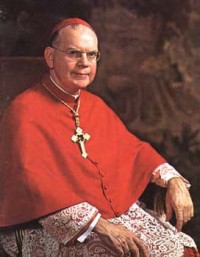
Telling Old Jokes About Catholics
The new issue of the London Review of Books is, as always, excellent-check out Elif Batuman's piece on creative writing programs-but I was particularly delighted by this bit from the letter section.
"Colm TóibÃn reminded me of a favourite joke (LRB, 19 August). Terence Cardinal Cooke of New York convened his bishops and ordered that in accordance with new austerity measures all clergy at Mass would henceforth be required to limit their number of attending altar boys to one and also to wear simple black robes rather than the usual colourful garb. All agreed. Mass the following Sunday began with a parade of obedient clergy: one boy per bishop, all black. But when Terence Cardinal Cooke entered the church, he was preceded and followed by no fewer than eight handsome boys and was dressed, head to toe, in beautiful robes of purple, red and gold. After he took his seat, the bishop seated in the row behind him leaned forward and whispered in his ear: ‘Terence, you bitch.'
Scott Haas
Cambridge, Massachusetts"
(I added the italics to "bitch," because that's really how the joke should be told.) Anyway, the TóibÃn thing is also worth your time.


I, for one, appreciate the added emphasis.
Re: the Elif Batuman piece: I don't understand this weird sideways vitriol directed at creative writing programs. Is this an American/British thing? I'm a Canadian creative writing MFA, and we seem to have none of the same kvetching about programs up here (or over here, as the case may be) that our Commonwealth head or neighbours to the south have. Creative writers in MFAs up here are just people who've gotten into the program and are choosing to experience their writing development in a peer based workshop environment. Nothing more, nothing less. Comparisons to MFAs as being where the less talented, "third world country" writers (as that piece suggests) hang out are odd in my mind.
In my program, at least, there is a huge amount of diversity in the writing styles and a respect of that by classmates/peers/instructors. No one is asked to scrub their writing of originality. If anything the main plus of the MFA for the writer is creating a supportive peer group that helps you deal with the multifaceted, sometimes demeaning act of being a writer, which is an otherwise solitary profession. In short–in Canada, in general, we're very comfortable with our MFA writing programs and their role. Some writers in MFA programs here succeed wildly, some succeed mildly, and some don't succeed. This is the same as the general writing world, but in the MFA world, we all help and guide each other through this process, which is a nice thing indeed. How could the US/UK programs be all that different?
What's the deal US/UK? Why so vitriolic? Please illuminate me.
That analogy she draws between MFA writing and "a developing country with no literary tradition" is tortured and unfortunate. One can see why she makes it, but it is based on caricature of "third world countries" that really doesn't hold water.
I certainly understand her exasperation at the frequently cavalier attitude of MFA programs towards literary history. Given that the apparent goal of these programs is to produce the next generation of literary writers, I agree that there should be a stronger emphasis on making sure that these writers know their predecessors and the genealogy of their field. But MFA programs have to deal with a time constraint that can only be understood by looking at the economics underlying their place in the university.
MFAs are usually 2-3 year programs that don't have room to require the kind of extensive course work that can be fit into a 6 or 7 year PhD program. But this time constraint results from the fact that, once they graduate, MFA students do not have the kind of jobs waiting for them that would make spending your 20s living in Iowa and making less than $20,000 a year if you're lucky an enticing proposition. Pressing on this from the other side is the declining publishing industry. All this needs to be addressed in any substantial consideration of the way MFA programs function. The real weakness of this piece is its failure to address the economic pressures that play a substantial role in the structure of MFA programs.
Is that Sam Neill?
Hmm, Alexander Cockburn recites the same joke in Corruptions of Empire, only with Francis Cardinal Spelman as the bitch.
Yes, I heard it about Spellman also — which since he was (most likely) gay, makes the joke approximately 53% better. I don't think Cooke was…
Gee, thanks, for the posting. Now please check out my Blog: http://www.shrinkinthekitchen.com