
Friday, April 2nd, 2010
33

Flicked Off: "Green Zone"
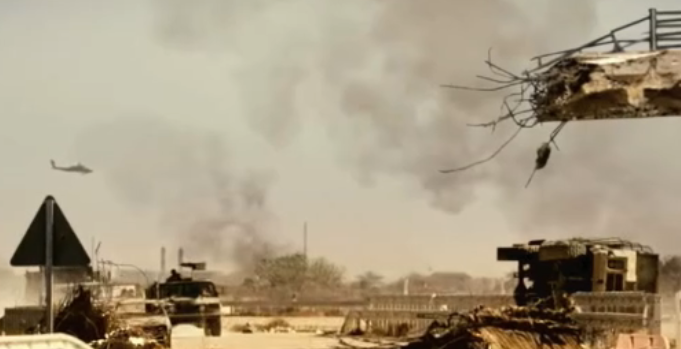
ka-boomI have seen the last four Paul Greengrass movies and the latest, "Green Zone," which I've finally watched, made me want to give up consuming fiction entirely. This is a story that in its key points intentionally sticks close up front to some very real, very serious issues-the great political lie of the invasion of Iraq, the falsification or at least very extreme inaccuracy of military intelligence regarding the Hussein regime's weapons and also the outrageously damaging involvement of major newspapers in spreading that misinformation. One of the most important topics of our time, right? And Paul Greengrass took those facts and made a lone hero cowboy shoot-em-up.

As one of the real soldier-consultant-actors in the film wrote: "Paul wanted to create an action thriller that would not only make the audience feel like they were with us in Iraq but also take them on an adventure filled with political conspiracy and a hero against all odds. After talking with Paul I felt less anticipation that this would be an accurate portrayal of the MET teams and more of an action-packed thriller set in Iraq…. Since this film, my friends and family have all been asking me the same question, 'How much of 'Green Zone' was true?' The short answer is very little."

Then what purpose is the film? The film is simply an action thriller tarted up with gravitas, and people's lives. He used these topics to make what he thought would be a blockbuster. It's a thriller: he wanted to inflame people's lusts to see someone shoot people. I'm sure Greengrass feels very strongly about the political topics, though! I do too! Ideally, I'd like someone to make sense of it, and convey information about it! Why wouldn't he want that?

When Tony Scott reviewed the movie in the Times, he wrote, of the patented night vision, low-light, shaky faux documentary camera style that makes the two Greengrass Bourne movies indistinguishable from Green Zone: "Mr. Greengrass has never been interested in technique for its own sake." Right! He's interested in this technique for a reason: to convey the lie of "this is real" and "you are there." This is fake. This is pornography. This is, really, total bullshit. And I would seriously stop consuming fiction right now, in protest, for real-except I'm in the middle of a pretty decent Alastair Reynolds book and that I don't want to give up! It's about a team of people searching for terrible weapons in the middle of an endless war? Except it's set in the year 2605 and it's NOT AN ALLEGORY. It's.. made up! Fiction! Just like United 93 and Green Zone really are.

I did not think I could be more offended by a movie than I was by United 93, Greengrass' historically based (obviously) death porno film about 9/11. His made-up narrative about the (real) terrible things that happened on that flight was about as realistic as Snakes on a Plane. And his "style" was pornography then and it's even more foul now. Why do we want to have works of art that make up lies about important things? Why could that possibly be a good thing? It's a deep and senseless blurring of the historical record, for starters. Tony Scott concluded this: "it has the rough authority of novelistic truth." Well, that's nuts. Authority is what Greengrass is grasping for, sure. And he conveys it, with his tricks and his incredible recreations of Baghdad and all that. But truth, no matter what James Frey says, doesn't have gradations.

33 Comments / Post A Comment

KarenUhOh (#19)

Maybe you need to give up historical fiction.

History boggles the bejeezus out of storytellers. Because it, like, uh, happened and stuff.

kneetoe (#1,881)

And Greengrass. He definitely needs to give up Greengrass.

This review makes Green Zone (which I haven't seen) sound like the anti- The Ghost Writer (which I have seen). Is that a fair statement?

Also, (someone) please elaborate on why United 93 is "about as realistic as Snakes on a Plane ". I saw it years ago and didn't think much of it. I know no one knows what really happened on that plane, but I figured it was a pretty close approximation. I feel wrong about my figuring and I want to know why!

"Why do we want to have works of art that make up lies about important things?"

I cannot wait for your review of "Abraham Lincoln: Vampire Hunter".

conklin (#364)

Wasn't that the subtitle of Birth of a Nation?

skahammer (#587)

Finally, someone to join my grass-roots campaign to produce films out of great achievements in contract drafting. "AOL/TWX Deal Memo," with George Clooney as Gerald Levin and Paul Rudd as Steve Case, plus Christopher Plummer as the ghost of Steve Ross, is now one step closer to your neighborhood multiplex. Momentum!

barnhouse (#1,326)

God yes. This is maybe my favorite thing that Choire has written here. Talk about good questions that need askin'. Terrible, and also exhilarating because true.

Dickdogfood (#650)

You could've seen Kiarostami's Close-Up at the Film Forum instead. THINK ABOUT IT.

irishbreakfast (#4,123)

I agree with the criticism of Green Zone–to a point. I found it less despicable than his 9/11 movie; perhaps because I knew someone who was killed in the latter but not in the former war. My question: can we judge all such movies by one criteria? Ok, so we throw out Greengrass. What about Three Kings? Absolute bunk with some maybe-true anecdotes thrown in, and yet it gave a real sense of the corruption and cynical/incestual power-plays in our first Gulf War. Can any film, even a documentary, actually convey what it 'is like' for at least a small segment of those involved? And is authenticity the requisite criteria? I think of the relatively recent assualt of the Hanksian-Speilbergian visual encomia to WW2. In such movies: does making it seem more real–for example, that 500 minute (or whatever) single shot of the storming of the beach at Normandy–mean that it is accurate? Is it all about getting the right kind of button on the grunt's pants? Or, is it better if a movie attempts to reflect the events not as they happened, but rather to represent the experience of the men who were there–is this somehow more "legitimate?" Or is it all too frequently a relfection of a 'vision," in this case an excercise in turning yet another of history's worst massacres into a transcendental moment? (Full disclosure: I HATE Spielberg movies. All of 'em.)

deepomega (#1,720)

Good points all! But! The thing is, WW2 is sort of historically out of reach. The people who were involved are gone or going, the stories themselves are so distant as to be hard to reconstruct. This is not the case with Iraq, where there are dudes, who were there and are acting in the movie as basically themselves, and yet the movie doesn't bother trying to get anything right! In other words, I think "trying to get the tone" is only really a valid excuse for history long enough ago that that's as good as you're gonna get. Especially when there are all these cinematic techniques being used to convey a false sense of authenticity.

irishbreakfast (#4,123)

May I steal your phrase "false sense of authenticity,"? I shall, whether you give permission or not.
Your phrase is, I think, at the heart of the matter. And I don't think that a false sense of authenticity is always a bad thing (see Three Kings). My question is how can we identify the ultimate effect on the audience–and by effect I'm not talking about whether a movie makes you cry. Which are more "relevant:" films that attempt to portray facts as they are known but draw little attention and less audience; those that promote revisionist history and have wider screenings, or the big fat blockbusters that showcase a particular director's world-view (and a studio's idea of what will bring in the bucks). As for the fact that participants are dying off: yes. But the Library of Congress (bless their hearts) has extensive documentation of the memories of those who were there. All memories are skewed, and I think that they probably become more so over time. But I digress: what are the obligations–if any–imposed upon the creation of a movie based on a recent historical event?

deepomega (#1,720)

Well the obligations in the DeepOmegaVerse, where air conditioning was invented in 1905 and Vietnam was won by superheroes, are that a recent historical event should be aware of its own pretenses. It shouldn't be feigning authenticity or accuracy when it is VERY CLEAR is has neither.

A metaphor! District B-13 is a sorta hammy action movie about parkour, with two of the inventors of parkour starring in it. It has lots of hollywood style stunt work, but largely done authentically – no wires, not much in the way of crash mats, etc. I trusted this because of the parkourists involved, and on further research – hey! – it turns out they did it pretty authentically. Good job!

Green Zone seems to try to trade on "ripped from the headlines", "real soldiers involved" authenticity, but in actuality is a pile of bullshit. It's billed as the first major-star-blockbuster "real" Iraq war movie, but really it's the Bourne Identity in Iraq. So I'd say:

The obligation is to be honest about your movie's relationship to reality. Don't claim that you had geophysicists work on your shitty envirodisaster movie (cough The Core cough), don't act like your movie is a The Wire style fictional documentary when it isn't.

Jared (#1,227)

Where is it claimed that Green Zone is accurate? Greengrass has been up front about it being basically "Bourne Identity in Iraq."

Also, WW2 is not historically out of reach, and there are plenty of war buffs very willing to comment on the accuracy of the strategy, not just the details of the uniforms. I think the problem with Saving Private Ryan, Band of Brothers et. al. is that we're too CLOSE, i.e. too invested in the cultural politics of the war.

johnpseudonym (#1,452)

I agree with you about Green Zone wholeheartedly. However, if you are implying that pornography is total bullshit I do not want to exist in the world you live in.

And I would seriously stop commenting on the internet right now, in protest, for real — except I'm in the middle of writing a pretty decent comment, that I do not want to give up! It's a meta-comment about a lone commenter hoping to gently and lovingly take the piss out of a (slightly) overwrought movie review where the critic is really fucking upset (and shocked?1) that a director of Hollywood movie took artistic liberties with a historical event while simultaneously avoiding messy political issues — in favor of explosions.

barnhouse (#1,326)

Well no though, because this thing is not an 'historical event' when there are thousands and thousands of people there this very minute because of the situation thus 'dramatized', and so these liberties taken have a real and bad effect on actual ongoing reality, is the thing, here.

deepomega (#1,720)

Better sentences than what I wrote above! Correct. In a decade we'll be able to write blockbuster fiction about iraq (assuming it's over then). But not yet!

Ah, I see it is a matter of "too soon" not "this is bullshit." Thanks for clarifying.

But, this "too soon" argument does not hold water. War movies have always been made while that same war was ongoing.

Take a gander.

http://en.wikipedia.org/wiki/List_of_World_War_II_films

deepomega (#1,720)

As with much in life, I won't accept the pop culture of the 30s/40s/50s as an excuse for doing lame things.

shostakobitch (#1,692)

I woke up this morning and, after practicing my knowing smile a few times, realized I'm ready to watch and enjoy a movie about the Falkland Islands War. But not Grenada; "Heartbreak Ridge" was too soon.

I was referring to "historical event" in the sense that the Iraq War and the lack of WMD's was a significant, and yes, historical event. The fact that there is still an large US presence in Iraq does not change this.

How has this movie had a "very real and bad effect" on what is currently going on in Iraq? That is quite a statement. Please advise.

shostakobitch (#1,692)

If Greengrass doesn't cap out the first-dollar gross portion of his deal on this one, CAA will pull out of Najaf.

barnhouse (#1,326)

Oh! Okay. To begin, what I said was, what's having a real and bad effect is 'taking liberties' as in, playing fast and loose with the truth, in general, about ongoing events. This movie qualifies, though, and will qualify until the last U.S. military vehicle has left Iraq.

So we've got this really bad political situation in this country with one completely delusional, lying, self-serving faction hell-bent on whipping up the guns-n-god-fearin' into electing them some more. These same people are also in the pockets of the military-industrial complex. Indeed they very nearly made an irreversible wreck of the whole country by means of propagandist shenanigans not at all dissimilar to what Choire condemns above.

Isn't it obvious that the last thing we need is our biggest movie star turning the genesis of the Iraq war into a video game for public delectation? Doesn't it further blur the already-too-blurry line between journalism, history, and 'entertainment'?

shostakobitch (#1,692)

It's only delectation if you enjoy it. This movie's biggest sin is looking boring and preachy as shit, which is probably why it is kind of a flop. And it can't even be the exciting, spectacular "Heaven's Gate" kind of flop. If it were so line-blurringly divisive, people would be watching it either for political reasons or out of curiosity. Instead we get to argue about what we "need" right now. Maybe they should have tried 3-d or on-set titty shirt pics of Salma Hayek.

Jared (#1,227)

In partial defense of Greengrass: his films seem to be about the inability to know what's going on (on United 93, in Jason Bourne's past), and his style is very appropriate to this. That is, the shaky-cam "intensified continuity" is not there (only?) to make the movie look realistic, but to put the audience through a certain amount of effort to follow the movie. I haven't seen GZ, but it's possible that the experience of watching it is supposed to mirror the act of looking for WMDs. It's not too soon to make a good film about Iraq (Hurt Locker WAS about "why we fight," in spite of any inaccuracies). It's just too soon to tell whether or not Greengrass's epistemological conceits (thematic and stylistic) are a permanent addition to film vocabulary. His films (all films) are about film style; the content in his case seems to mirror the style in suggestive ways.

doubled277 (#2,783)

I agree with you whole-heartedly. I am particularly in-league with you on this: "…(all films) are about film style"… I believe that not only are all films are primarly about film itself, but also all art has as its primary subject, the art-form itself (painting is about painting; novels are about novels).

JHenryWaugh (#212)

Choire, have you read (or read reviews of) David Shields' Reality Manifesto?

Much of what you are saying is similar to Shields' conclusions.

doubled277 (#2,783)

I'm sorry, but United 93 is a great film. One of the best in the last decade. I can accept why you think it's pornography, and don't entirely disagree that it is, but would like to offer that even with it's somewhat pornographic nature, it is at its heart the film we need about that day. It offers us a glimpse of courage and sacrfice, completely stripped of pretense that so much of our modern heros have. Any modern hero comes with the baggage of being termed a hero; a distinction that now carries so much baggage as to completely deflate the very notion of what is heroic.

This film coupled with the moment in time it is about (because the film without its relation to that day is certainly meaningless) offers a purely emotional gateway into a true moment of potential heroism in the face of absolute evil (not the kind of evil that Dubya preaches about, mind you – but the kind that James Berardinelli would preach about – the type of evil in which these terrorists would take up this "cause" without realizing that their purpose – to communicate with the Western World – is completely mis-interpreted to the point that their act, and death, becomes meaningless.) In the sense that the terrorists failed to deliver the message they desired to, and thus created senseless violence both on that day and thereafter, United 93 is an amazing counter-point, because it delivers its message directly to its intended (if not as widely intended) audience: that given the opportunity, we as Americans and as human beings in general, still have the potential, even among the din of the post-modern world, to stand up and extoll true bravery in the face of insormountable odds, and also, can choose (as those on the flight possibly did) to sacrifice ourselves for a greater good.

We so often lament the passing of the greatest generation because our subsequent generations seem lost without a greater purpose. I think this film aimed to show that that purpose is still within us; that same ability to stand up to and fight for a great cause as we did in WWII, is not lost, just waiting inside of us, and given the opportunity, we can tap into it. A message that lacks cyncism like this is not easy to deliver in our post-post-post ironic world. I think Greengrass found a way to deliver that message wonderfully in that film.

irishbreakfast (#4,123)

The problem with all of this is that those are real people. For those of us who knew any of them it is horribly painful–and as I type this I realize, again, that this is beside the point. Even more painful is the notion that they are "heroes"–however much your dismiss the term it sticks around– because of the way they responded to the unconcievable. At the same time they are frequently judged to be essentially letting the audience down when it becomes known that they were real folks, with real flaws, before they boarded those planes. And there is also the fact that they didn't know they were fighting for or against any particular ideology, for their country or against terrorists. If anything that is one thing I do like about Greengrass's film: if you ignore large parts of it he does show that they fought for their lives and lost.

doubled277 (#2,783)

Good points, all of them. While I disagree that (in the film at least) they weren't fighting for more than just their lives, I do agree that they were first-and-foremost fighting for their lives. I think theres is evidence both in the film, and in the record of the flight, that they had a sense of what else they were fighting for, though.

Dan Kois (#646)

Someone needs to read THE THINGS THEY CARRIED again, I think.

+1 for Alastair Reynolds, who I'm reading RIGHT NOW TOO. I've also been jamming through a stack of Iain M. Banks, who runs with similar themes but is a better stylist.

Thomas Espinosa (#7,353)

Maybe you should reconsider that a film is a film. A fictional piece about a subject showing the point of view of one or more people (writer/director/producer/actors) mostly, trying to TELL A STORY and make sense about this story. Do you know the word ALLEGORY? Well Green zone is a superb interpretation of what is going on in a country like Irak, of how complicated the politic implications are in foreign politics management. And how one guy who thinks he can do something will not succeed alone… And about the style, don't forget that Mr Greengrass was a war cameraman before…

Post a Comment